 Aim Constraint
Rotates targets so a local axis points at blended sources.
| Node type | RigExecAimConstraint |
| Example | aim_constraint.usda |
On this page:
Overview
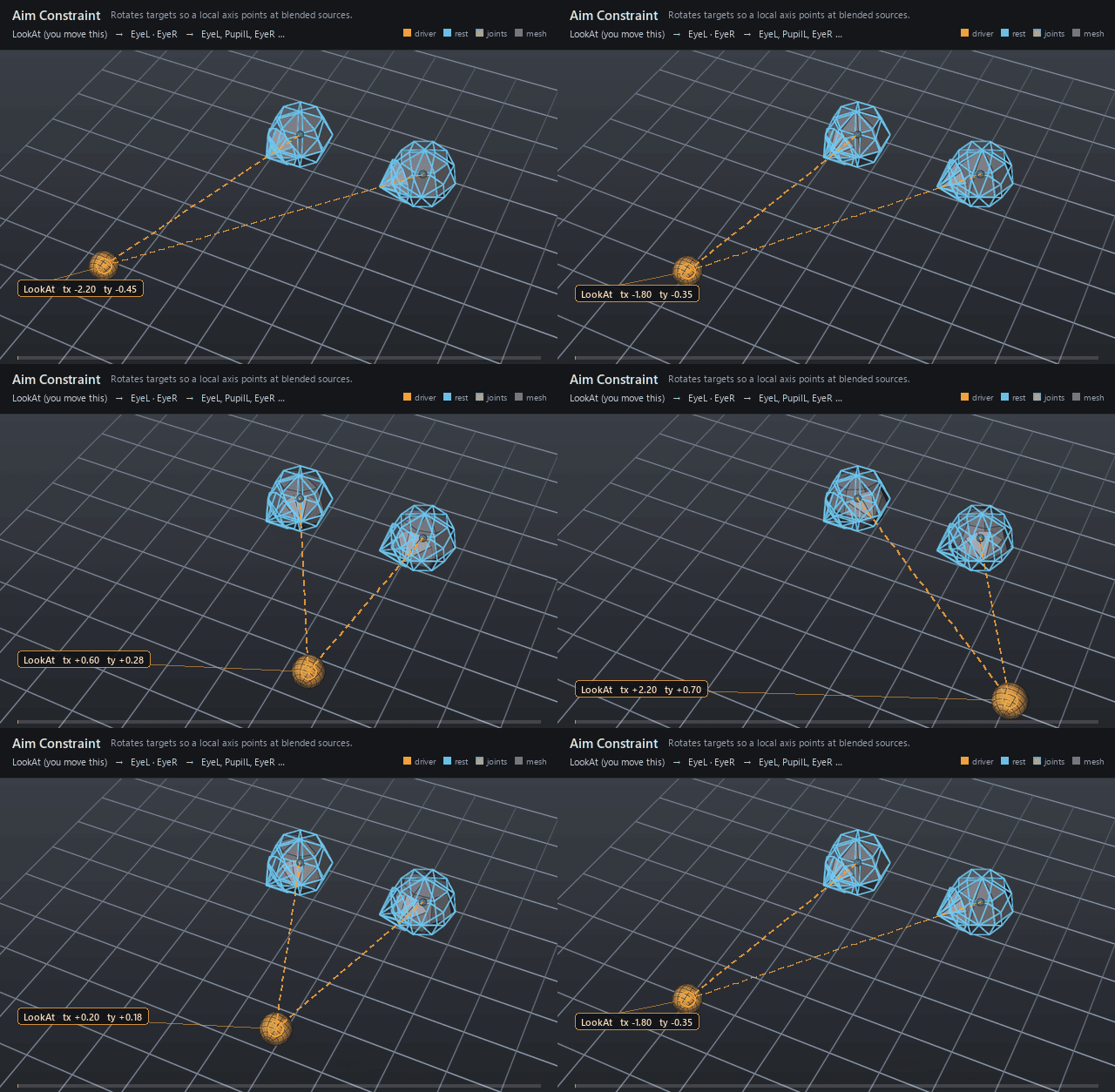
FBX-style aim: the transform named by rigExec:moves rotates so its
aim vector points at the weighted source position, stabilized by the
world-up policy. The everyday use is eyes tracking a look-at control,
but the same node aims turrets, spotlights, and driven props.
FBX-style aim constraint. It rotates each transform named by RigExecMoverAPI rigExec:moves so inputs:aimVector points toward the weighted source position, with the selected world-up policy, axis masks, offset, and inherited normalized weight.
rigExec:aimTarget, rigExec:aimAxis, rigExec:upPolicy, and rigExec:preserve are retained as the legacy RigExec authoring contract so existing assets keep their authored fields. New assets use the inherited ordered rigExec:sources relationship and the FBX-style inputs below.
How it works
In the pose phase the constraint blends the ordered rigExec:sources
into one goal position, builds the aim rotation from inputs:aimVector,
inputs:upVector, and the world-up mode, then mixes the result over the
incoming pose through the common mover envelope. Axis masks and the
rotation offset shape the result per channel, and only rotation is
written. New assets use sources; aimTarget/aimAxis/upPolicy/
preserve are the legacy contract kept for existing stages.
Wiring
| Relationship | Points to | Required |
|---|---|---|
rigExec:sources |
Ordered transform sources to track. | yes |
rigExec:moves |
Exactly one joint or provider to re-aim (pose phase). | yes |
rigExec:worldUpObject |
Provider for object world-up modes. | no |
Parameters
Common mover envelope
rigExec:moves
Relationship.
Reserved write-set relationship: exact prim/property targets.
inputs:enabled
Type: bool. Default: true.
Shape-preserving enable. Disabled movers pass their preceding revision through unchanged (value-only edit).
inputs:defaultWeight
Type: float. Default: 1.
Normalized common mover envelope in [0, 1]. With no bound rigExec:weightObject it broadcasts over every logical element: zero passes the incoming value through bit-for-bit and one applies the mover's full-strength result. A non-finite value or one outside [0, 1] passes the incoming value through with a diagnostic.
rigExec:weightObject
Relationship.
Optional compatible total weight field, at most one target. When bound, the weight object's values (including its own sparse or constant fallback) supply the common envelope instead of inputs:defaultWeight. Target, domain, and cardinality must match each mover application; an incompatible binding is a compile error. A multi-target mover may bind only a constant operation envelope whose weightTarget is the mover prim itself; that one value broadcasts to every application of the atomic mover.
Constraint base
rigExec:locked
Type: uniform bool. Default: false.
Authoring lock metadata for application interchange. Evaluation remains active while locked; use RigExecMoverAPI inputs:enabled or inputs:defaultWeight to disable or blend the operation.
inputs:affectTranslationX
Type: bool. Default: true.
Per-axis translation mask. Ignored groups are a compile error.
inputs:affectTranslationY
Type: bool. Default: true.
inputs:affectTranslationZ
Type: bool. Default: true.
inputs:affectRotationX
Type: bool. Default: true.
Per-axis rotation mask. Ignored groups are a compile error.
inputs:affectRotationY
Type: bool. Default: true.
inputs:affectRotationZ
Type: bool. Default: true.
inputs:affectScaleX
Type: bool. Default: true.
Per-axis scale mask. Ignored groups are a compile error. RigExecParentConstraint overrides the default to false to match the FBX runtime, which leaves scale off unless it is asked for.
inputs:affectScaleY
Type: bool. Default: true.
inputs:affectScaleZ
Type: bool. Default: true.
inputs:translationOffset
Type: double3. Default: (0, 0, 0).
Additive translation offset applied after the source blend.
inputs:rotationOffset
Type: double3. Default: (0, 0, 0).
Additive Euler rotation offset in degrees, applied after the blend.
inputs:scaleOffset
Type: double3. Default: (0, 0, 0).
ADDITIVE scale offset applied after the blend, which is why its identity is (0, 0, 0) and not (1, 1, 1): the kernel computes blendedScale + offset. A multiplicative offset would be a different operator, not a different default.
rigExec:rotationOrder
Type: uniform token. Default: "XYZ".
Valid values: XYZ, XZY, YXZ, YZX, ZXY, ZYX.
Euler order for the operators that compose a rotation. Authoring it on one that does not is a compile error.
Ordered sources
rigExec:sources
Relationship.
Ordered transform sources. Order is preserved through composition because it identifies entries in every parallel source array.
inputs:sourceWeights
Type: float[]. Default: [].
Per-source weights parallel to rigExec:sources. An empty array gives every source equal, full weight. A non-empty array must have exactly one entry per source. Weights are relative: the sources mix by weight over their total, and each must be finite and not negative.
Node parameters
rigExec:worldUpRotationOnly
Type: uniform bool. Default: false.
objectRotationUp: take the world-up direction from the up object's ROTATION alone, orthonormalizing its frame first. A rotation extracted from a scaled or sheared frame is not that frame's rotation, so under a scaled rig root the derived up can swing far enough to turn an aim-constrained foot. Off (the default) extracts the rotation from the up object's frame as authored.
inputs:aimVector
Type: double3. Default: (1, 0, 0).
Local-space vector that points toward the constrained aim direction.
inputs:upVector
Type: double3. Default: (0, 1, 0).
Local-space vector used to stabilize roll around the aim direction.
inputs:worldUpVector
Type: double3. Default: (0, 1, 0).
World-space up direction for the vector world-up mode. For objectRotationUp it is expressed in the up object's axes and turned by that object's rotation, or used as is when no up object is named.
rigExec:worldUpObject
Relationship.
Optional single transform provider used by object world-up modes. With none named, objectUp points the up at the scene origin.
rigExec:worldUpType
Type: uniform token. Default: "none".
Valid values: sceneUp, objectUp, objectRotationUp, vector, none.
rigExec:aimTarget
Relationship.
Legacy single aim source, read only when rigExec:sources is empty; retained for backward compatibility. With it and no world-up direction, the solve keeps the input frame's up rather than taking the minimum swing.
rigExec:aimAxis
Type: uniform token. Default: "x".
Valid values: x, y, z.
Legacy positive-axis selector retained for existing assets: it selects the aim axis only when inputs:aimVector is unauthored.
rigExec:upPolicy
Type: uniform token. Default: "preserveInputUp".
Valid values: preserveInputUp.
Legacy up policy retained for existing assets.
rigExec:preserve
Type: uniform token[]. Default: ["origin", "scale"].
Legacy component-preservation declaration retained for existing assets. Only the default is accepted; any other value is a compile error, and the inputs:affect* masks choose the channels instead.
Example
Two eye joints track a look-at control that sweeps across the front of the face. The control carries its own solid sphere guide, so the thing being aimed at is a visible orange ball rather than an implied point: it slides side to side and rises and falls, and each eye swings through about 70 degrees horizontally and another 20 vertically following it. Each eye is a small sphere with a bright iris cone on its front, both skinned rigidly to the aimed joint, so the iris points wherever the eye is aimed at every angle. Both eyes converge on the same target, so the closer the ball comes the more their lines of sight cross.
Open it live with:
Re-render the GIF above with:
Tips
- Put pose-phase constraints in a scope ordered below Geometry (bottom executes first) so skinning reads their final output.
rigExec:worldUpType = "vector"withinputs:worldUpVector+Y keeps eyes level while they swing;noneapplies no roll correction at all (FBX minimum swing) -- but only oncerigExec:sourcesis authored, because the legacyrigExec:aimTargetspelling still preserves the input up.- Make the look-at handle visible: it is an ordinary control, so on the RigExecControl prim
guide:shape = "sphere"withguide:drawMode = "geometry"draws a solid ball at its posed origin instead of the default wire circle, sized byguide:scaleX/Y/Ztimes the evaluated frame scale. Seeing the target is what makes an aim rig readable -- an eye pointing at nothing is just a rotating eye.