 Rotation Constraint
Copies orientation from blended sources, leaving position alone.
| Node type | RigExecRotationConstraint |
| Example | rotation_constraint.usda |
On this page:
Overview
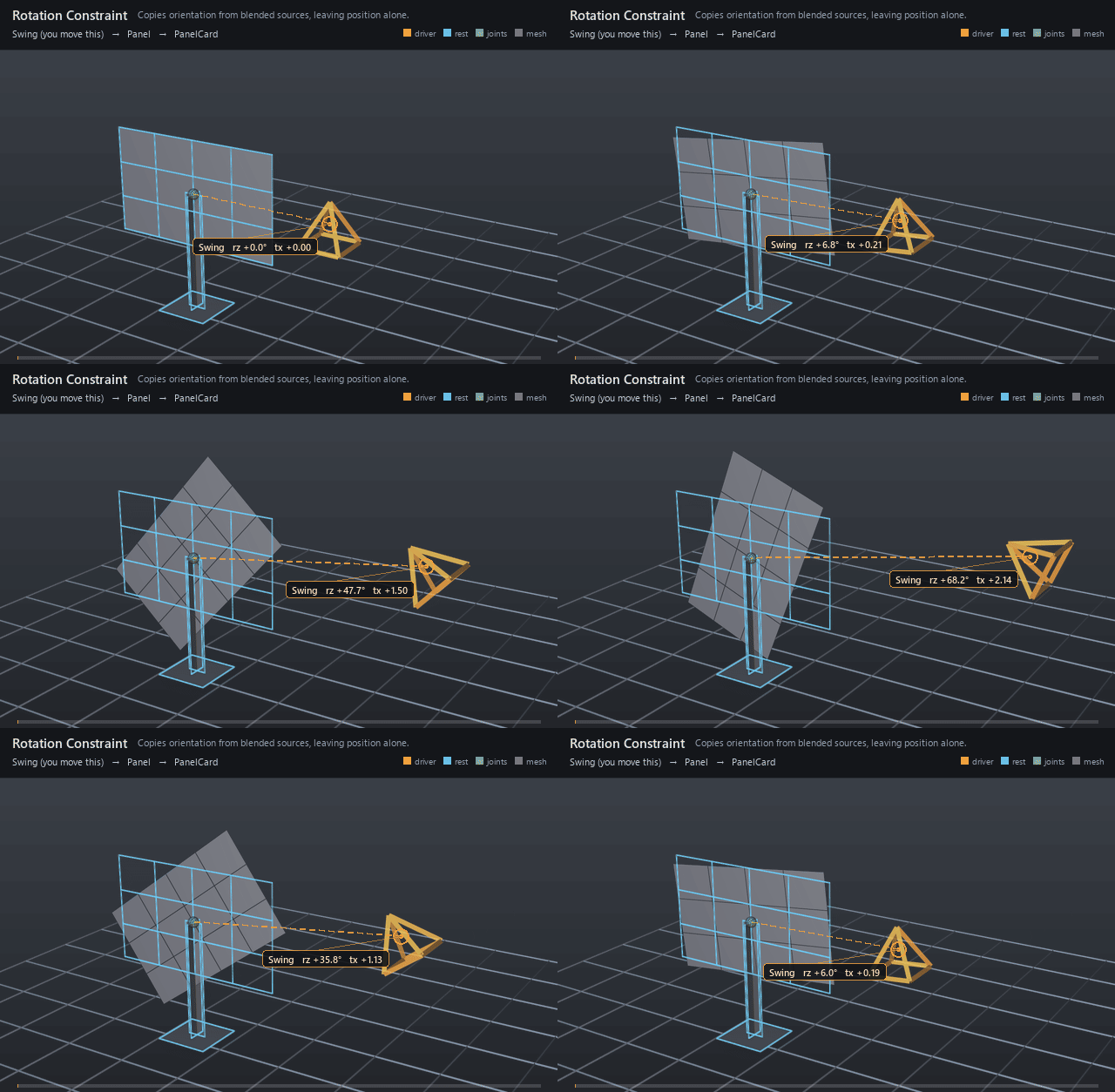
FBX-style rotation copy: the prim named by rigExec:moves takes its
orientation from the blended rigExec:sources, while its translation,
scale, and shear pass through untouched. That split is the whole point —
a panel bolted to a post can turn with a distant handle without drifting
off the post. Per-axis masks and a degrees offset shape which part of the
source orientation is actually copied.
FBX-style rotation constraint. It blends the ordered source orientations, applies the authored Euler offset and axis masks, and blends the result over the incoming pose by the common MoverAPI envelope.
An optional rigExec:space relationship, not declared by this schema, names one RigExecControl or RigExecJoint, typically the rig's master. The input and every source are then measured with that provider's motion from its default frame removed, the masks run in that space, and the result is carried back, so a partial mask does not discard part of the master's rotation. More than one target is a compile error; a target that is not a control or joint is ignored.
How it works
It runs in the pose phase at its place in the pose stack, once the
constrained provider's incoming frame is known. The kernel decomposes
that incoming frame, converts each source's orientation to Euler degrees
in rigExec:rotationOrder, and accumulates weighted shortest per-axis
deltas against the first positive-weight source, so the fully constrained
result depends only on the sources. inputs:rotationOffset is added in
degrees, the inputs:affectRotation* mask picks which axes are written,
and the common mover envelope (inputs:defaultWeight, or a bound
rigExec:weightObject) blends per axis between the incoming Euler and the
target one. Only the rotation of the decomposed frame is replaced before
the frame is rebuilt, which is why the origin and scale survive.
Wiring
| Relationship | Points to | Required |
|---|---|---|
rigExec:sources |
Ordered transform providers whose orientations are blended. | yes |
rigExec:moves |
Exactly one transform-provider prim to re-orient. | yes |
inputs:sourceWeights |
Per-source weights parallel to rigExec:sources; empty means every source at full weight. |
no |
rigExec:weightObject |
Weight field supplying the envelope instead of inputs:defaultWeight. |
no |
Parameters
Common mover envelope
rigExec:moves
Relationship.
Reserved write-set relationship: exact prim/property targets.
inputs:enabled
Type: bool. Default: true.
Shape-preserving enable. Disabled movers pass their preceding revision through unchanged (value-only edit).
inputs:defaultWeight
Type: float. Default: 1.
Normalized common mover envelope in [0, 1]. With no bound rigExec:weightObject it broadcasts over every logical element: zero passes the incoming value through bit-for-bit and one applies the mover's full-strength result. A non-finite value or one outside [0, 1] passes the incoming value through with a diagnostic.
rigExec:weightObject
Relationship.
Optional compatible total weight field, at most one target. When bound, the weight object's values (including its own sparse or constant fallback) supply the common envelope instead of inputs:defaultWeight. Target, domain, and cardinality must match each mover application; an incompatible binding is a compile error. A multi-target mover may bind only a constant operation envelope whose weightTarget is the mover prim itself; that one value broadcasts to every application of the atomic mover.
Constraint base
rigExec:locked
Type: uniform bool. Default: false.
Authoring lock metadata for application interchange. Evaluation remains active while locked; use RigExecMoverAPI inputs:enabled or inputs:defaultWeight to disable or blend the operation.
inputs:affectTranslationX
Type: bool. Default: true.
Per-axis translation mask. Ignored groups are a compile error.
inputs:affectTranslationY
Type: bool. Default: true.
inputs:affectTranslationZ
Type: bool. Default: true.
inputs:affectRotationX
Type: bool. Default: true.
Per-axis rotation mask. Ignored groups are a compile error.
inputs:affectRotationY
Type: bool. Default: true.
inputs:affectRotationZ
Type: bool. Default: true.
inputs:affectScaleX
Type: bool. Default: true.
Per-axis scale mask. Ignored groups are a compile error. RigExecParentConstraint overrides the default to false to match the FBX runtime, which leaves scale off unless it is asked for.
inputs:affectScaleY
Type: bool. Default: true.
inputs:affectScaleZ
Type: bool. Default: true.
inputs:translationOffset
Type: double3. Default: (0, 0, 0).
Additive translation offset applied after the source blend.
inputs:rotationOffset
Type: double3. Default: (0, 0, 0).
Additive Euler rotation offset in degrees, applied after the blend.
inputs:scaleOffset
Type: double3. Default: (0, 0, 0).
ADDITIVE scale offset applied after the blend, which is why its identity is (0, 0, 0) and not (1, 1, 1): the kernel computes blendedScale + offset. A multiplicative offset would be a different operator, not a different default.
rigExec:rotationOrder
Type: uniform token. Default: "XYZ".
Valid values: XYZ, XZY, YXZ, YZX, ZXY, ZYX.
Euler order for the operators that compose a rotation. Authoring it on one that does not is a compile error.
Ordered sources
rigExec:sources
Relationship.
Ordered transform sources. Order is preserved through composition because it identifies entries in every parallel source array.
inputs:sourceWeights
Type: float[]. Default: [].
Per-source weights parallel to rigExec:sources. An empty array gives every source equal, full weight. A non-empty array must have exactly one entry per source. Weights are relative: the sources mix by weight over their total, and each must be finite and not negative.
Node parameters
Example
A Swing control rolls about Z and, at the same time, slides up and to
the right; a rotation constraint copies its orientation onto the Panel
joint, and a matrix mover skins a twelve-quad card (PanelCard) to that
joint. inputs:rotationOffset stays at zero and the
inputs:affectRotationX/Y/Z masks stay at their all-on defaults here, so
what you see is the unshaped copy — the source orientation and nothing
else. Watch the handle slide up and to the right while the card's base
never leaves the post — only the roll crosses the constraint.
Open it live with:
Re-render the GIF above with:
Tips
- Rotation is the only channel this operator writes: authoring
inputs:affectTranslation*,inputs:affectScale*,inputs:translationOffset, orinputs:scaleOffseton it is a compile error rather than a silent no-op. - A zero envelope is an exact pass-through —
inputs:enabled = falseorinputs:defaultWeight = 0leaves the incoming pose bit-for-bit, and the sources are not even resolved. - Blending two sources works per Euler component against the first positive-weight source, so keep
rigExec:rotationOrdermatched to how the sources are keyed and their per-axis values within half a turn of each other.