 Twist Distribution
Unwinds roll between two frames across N interpolated frames.
| Node type | RigExecTwistDistribution |
| Example | twist_distribution.usda |
On this page:
Overview
Takes the twist between a start and an end provider and spreads it over a graduated run of frames — the standard forearm/spine setup where the middle of a limb should turn half as far as the end. Output joints can index any single frame of the run without listing all of them.
Distributes unwrapped twist over N frames between start and end providers. Publishes computePointFrameArray.
How it works
The solver unwraps the endpoint twist, distributes it with minimum
energy over rigExec:count frames weighted by rigExec:weights, and
optionally adds inputs:twistTurns of extra aim-axis winding (integers
preserve the endpoints; fractions animate). Each claimed joint rides the
frame picked by its rigExec:jointElements entry.
Wiring
| Relationship | Points to | Required |
|---|---|---|
rigExec:start |
Provider holding the zero-twist end. | yes |
rigExec:end |
Provider holding the full-twist end. | yes |
rigExec:joints |
Joints posed by picked distributed frames. | no |
Parameters
Node parameters
purpose
Type: uniform token. Default: "guide".
Render purpose, overriding UsdGeomImageable's default
fallback: joint and solver guides are DIAGNOSTICS, drawn when a
viewer asks for guides.
This is the stock attribute rather than a RigExec-specific token so
that the bounds and the drawing cannot disagree: UsdGeomBBoxCache
classifies a prim's extent by this exact attribute, and the results
scene index stamps the same resolved value onto the guide it
synthesizes. A control keeps the inherited default -- it is the
rig's interaction surface, not a diagnostic -- and authoring
guide on one moves both its drawing and its bounds together.
rigExec:start
Relationship.
rigExec:end
Relationship.
rigExec:count
Type: uniform int. Default: 1.
rigExec:weights
Type: uniform float[]. Default: [].
inputs:twistTurns
Type: double. Default: 0.
Signed additional aim-axis revolutions beyond the principal endpoint twist. Integer values preserve endpoint orientations while carrying multi-revolution winding; fractional values support animated winding and add the corresponding rotation at the end. The additional angle at sample k is 360 * inputs:twistTurns * weight[k] degrees.
rigExec:distribution
Type: uniform token. Default: "minimumEnergy".
Valid values: minimumEnergy.
rigExec:joints
Relationship.
Ordered output joints posed by the distributed twist frames. The compiler binds each joint to one aggregate element.
rigExec:jointElements
Type: uniform int[]. Default: [].
Optional aggregate element index for each rigExec:joints entry (parallel array). When absent/empty, element = list position. Lets a joint bind a specific distributed frame (e.g. the middle of an N-frame twist) without listing every element.
guide:radius
Type: double. Default: 1.0.
Radius of the sphere and cone drawn at each aggregate element: the exact counterpart of RigExecJoint's guide:radius, including the rule that zero or negative draws no guides at all, which is how a solver's diagnostics are turned off.
Without it the elements draw at Hydra's fallback radius of 1.0, which is proportionate on an asset authored at tens of units and several times the size of the whole character on one authored at one unit.
guide:displayColor
Type: color3f. Default: (0.3, 0.6, 1.0).
guide:displayOpacity
Type: float. Default: 0.5.
Example
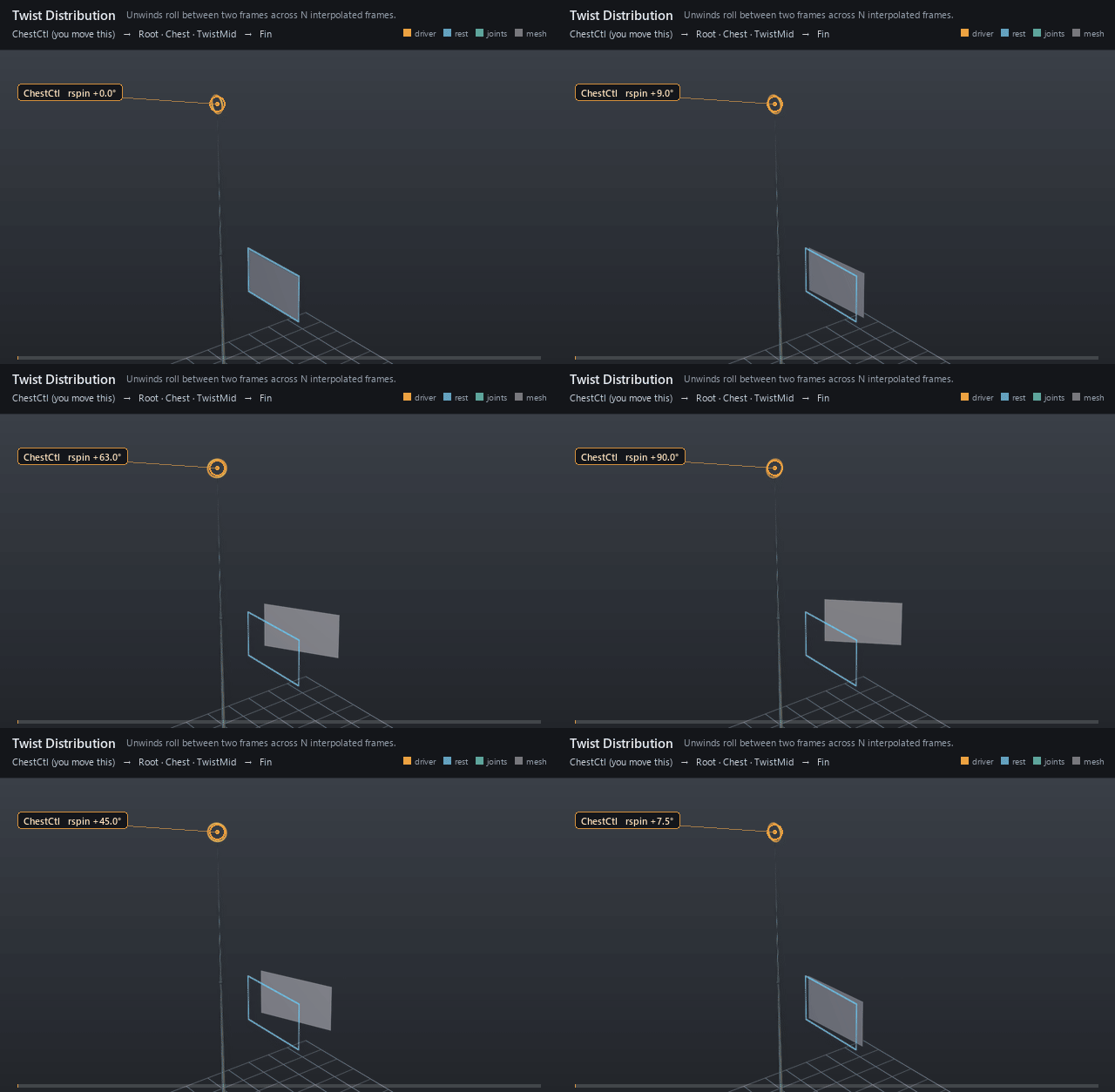
The chest spins 90 degrees about the spine axis while the root stays put. A mid-spine joint rides the middle of three distributed frames and turns half as far, swinging the fin card it skins.
Open it live with:
Re-render the GIF above with:
Tips
- Drive the end with
avars:rspin(roll about the bone axis), not a tilt: only axial roll becomes distributed twist. - Naming this solver on a Ribbon's
rigExec:twistFramesorders the ribbon after it but adds no twist: the ribbon's frames come from its driver curve alone.