 Curve Mover
Transports points through a solver's frame array, follows a NURBS wire curve, or emits frame origins.
| Node type | RigExecCurveMover |
| Example | curve_mover.usda |
On this page:
Overview
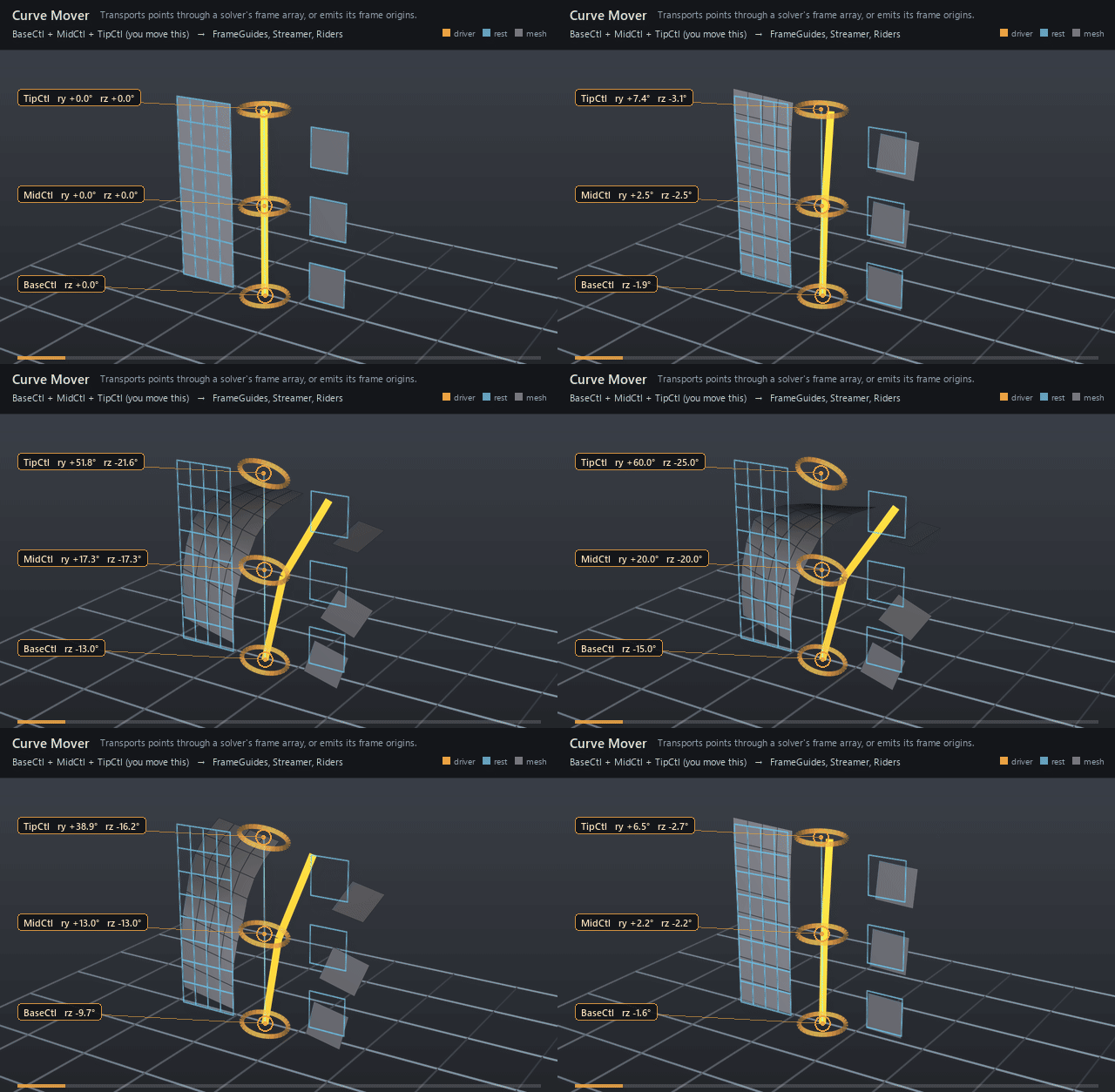
Frame transport for geometry. In ribbon mode each moved point
carries a bind parameter that picks a spot in the driver frame array, and
the point is mapped by the rest-relative rigid transform read there — so a
dense mesh spread across the parameter bends, while a prop whose every
vertex shares one parameter rides rigidly. In emitGuidePoints mode the
mover skips the bind and writes the frame origins straight out as points.
Neither mode samples a curve: the frames are the input, and any solver that
publishes a frame array — a ribbon, an FK chain, spline IK, a twist
distribution — can supply them. wire mode does read a curve: each point
moves by the displacement of the UsdGeomNurbsCurves named by
rigExec:driverCurve at the parameter it was bound to.
Moves an exact native UsdGeomPointBased points property by a curve, in one of the rigExec:mode forms: ribbon transport along a solver aggregate's frames, guide-point emission from those frames, or a wire driven by a UsdGeomNurbsCurves.
How it works
The mover runs as one revision on its rigExec:moves target's point
chain, reading the driver solver's frames after the pose phase has solved
them. It builds one rigid map per element from that element's rest
landmarks to its posed landmarks, then places each point by clamping its
bind u to [0, 1], scaling it across the array, and blending the two
neighbouring maps' results — so the array's cardinality, not a curve, sets
the resolution of the transport. Guide emission needs no bind at all: it
copies frame origin i to point i, and fails the revision if the counts
differ. In wire mode the mover instead reads the driver curve's posed
control points at the rigExecReadPhase declared on rigExec:driverCurve,
or poses them from rigExec:driverTransforms, and adds each point the
curve's displacement from its authored shape at the point's bind u, faded
over its bind distance by inputs:dropoffDistance. The compiler maintains
the moved mesh's normals and extent afterwards.
Wiring
| Relationship | Points to | Required |
|---|---|---|
rigExec:driverFrames |
Any solver publishing a frame array (ribbon, FK chain, spline IK, twist distribution). | ribbon and emitGuidePoints modes |
rigExec:bindCoordinates |
Per-point primvars:st; u picks the spot in the frame array, or in wire mode (u, d) is the rest curve's parameter and the point's distance from it. |
ribbon and wire modes |
rigExec:moves |
Exact native points property to write. | yes |
rigExec:driverCurve |
wire mode: the UsdGeomNurbsCurves whose displacement the points follow. Unread in the other modes, where the frames already carry the curve's shape. |
wire mode |
Parameters
Common mover envelope
rigExec:moves
Relationship.
Reserved write-set relationship: exact prim/property targets.
inputs:enabled
Type: bool. Default: true.
Shape-preserving enable. Disabled movers pass their preceding revision through unchanged (value-only edit).
inputs:defaultWeight
Type: float. Default: 1.
Normalized common mover envelope in [0, 1]. With no bound rigExec:weightObject it broadcasts over every logical element: zero passes the incoming value through bit-for-bit and one applies the mover's full-strength result. A non-finite value or one outside [0, 1] passes the incoming value through with a diagnostic.
rigExec:weightObject
Relationship.
Optional compatible total weight field, at most one target. When bound, the weight object's values (including its own sparse or constant fallback) supply the common envelope instead of inputs:defaultWeight. Target, domain, and cardinality must match each mover application; an incompatible binding is a compile error. A multi-target mover may bind only a constant operation envelope whose weightTarget is the mover prim itself; that one value broadcasts to every application of the atomic mover.
Node parameters
rigExec:driverCurve
Relationship.
rigExec:driverFrames
Relationship.
rigExec:bindCoordinates
Relationship.
rigExec:mode
Type: uniform token. Default: "ribbon".
Valid values: ribbon, emitGuidePoints, wire.
ribbon transports points along the frames of the solver aggregate rigExec:driverFrames names (normally a RigExecRibbon's), each at the parameter of its rigExec:bindCoordinates entry; emitGuidePoints writes those frames' positions, one frame per point; wire moves each point by the displacement of rigExec:driverCurve (a UsdGeomNurbsCurves) at the parameter it was bound to: p' = p + f(d) * (C(u) - C0(u)), with (u, d) per point from rigExec:bindCoordinates, C the curve's posed control points at rigExec:driverCurve's read phase and C0 its authored ones. With a sparse weight object the bind table may be sparse too: one (u, d) per weighted point, in the weight object's index order.
rigExec:driverTransforms
Relationship.
wire: move the driver curve's control points by matrix providers instead of reading its points: one provider per unique control point, or one for all. A periodic curve's repeated points take their unique point's provider. The posed point is C0 + w (M C0 - C0), M the provider measured against its entry in rigExec:driverTransformSpaces and w its inputs:driverWeights entry. No chain runs on the curve, so its points need no phased read; rigExecReadPhase metadata on this relationship chooses base or final for the providers.
rigExec:driverTransformSpaces
Relationship.
wire: the space each driver transform is measured against, parallel to rigExec:driverTransforms, or one for all, or none.
rigExec:driverDeltaFrame
Type: uniform token. Default: "local".
Valid values: local, posed.
wire: WHICH FRAME the driver's offset from its space is applied in. Only meaningful with rigExec:driverTransformSpaces.
local is what the measurement M = T * S^-1 gives, and in USD's row-vector convention that product is exactly the driver's LOCAL matrix: world = local * parent, so T * S^-1 cancels the space entirely. The curve's control points are world positions, so applying it to them uses a local offset as though it were a world one -- the offset points wherever it pointed at the bind pose, no matter where the space has since been carried.
posed conjugates that offset into the space's current frame, S^-1 * T, which is S^-1 * local * S. The offset then rides the space: same measurement gives 69.93 degrees against the arm's 70.00, with the length preserved exactly.
Both are IDENTITY when the driver sits at its space, at rest and posed alike, so neither makes the curve move merely because the space moved -- that is the skin's job and would be a double transform. They differ only once an animator touches the control.
local remains the default because the shipped face rig was built and measured against it; posed is what a wire riding a deforming limb wants. Set per mover, so the two can coexist while rigs migrate.
rigExec:pointFrame
Type: uniform token. Default: "rest".
Valid values: rest, posed.
wire: WHICH FRAME the points this wire moves are already in when it runs.
A wire adds a displacement read off its driver curve to the points it moves. The curve, the bind distances measured against it and the mesh rest points are all authored at the ASSET'S scale; a skin is what carries those points out of it. So the same displacement means two different things depending on where in the chain the wire sits, and only the asset knows which.
rest is a wire that runs BEFORE the skin on its target. Its displacement stays in the asset's units, because the skin will apply the rig's scale to it afterwards and applying it here too applies it twice.
posed is a wire that runs AFTER it, adding to points a skin has already carried into the rig's posed frame. Its displacement is carried there too: the scale the driver measurement took out goes back on, and nothing else does, so the wire moves the posed mesh as far as the posed rig moved.
The two corrections are in OPPOSITE directions, which is why one blanket rule cannot serve both families and why the wire has to say. Which one a given wire is, is not a rigging choice -- it is where the compiler put it relative to its skin -- so a build tool should author it from the compiled mover order rather than from a list kept by hand.
Both are IDENTICAL while nothing above the rig is scaled, because the scale in question measures one. A wire that names neither posed frame keeps the plain measurement bit for bit.
rigExec:space
Relationship.
wire: the prim whose movement away from its rest carries the whole rig -- normally a TRS master. Only meaningful with rigExec:driverTransforms and rigExec:pointFrame = "posed".
A posed wire adds a displacement computed in the uncarried frame to points a skin has already carried. With a space named, both control polygons are transformed by that space's rest->pose map (its computeMatrix) before the wire is evaluated, so the displacement is carried with the points; the scale-only correction of rigExec:pointFrame is then not applied beside it. Read at the phase declared on rigExec:driverTransforms.
inputs:driverWeights
Type: float[]. Default: [].
wire: per unique control point weight of its driver transform, or one for all; empty is 1.
rigExec:driverBaseTransforms
Relationship.
wire: an optional base motion applied to the curve AND its rest before the driver transforms, as a wire whose base curve rides the same deformers as its driver: B = C0 + wb (Mb C0 - C0), then C = B + w (M B - B), and the wire deforms by C - B. Same entry rules as rigExec:driverTransforms.
rigExec:driverBaseTransformSpaces
Relationship.
wire: the spaces of rigExec:driverBaseTransforms.
inputs:driverBaseWeights
Type: float[]. Default: [].
wire: per unique control point weight of the base motion.
inputs:dropoffDistance
Type: float. Default: 0.
wire: distance over which a point's pull from the curve falls to zero, as 1 - smoothstep(0, dropoffDistance, d) with d the point's rest distance from the curve. 0 applies no falloff.
Example
Three controls stacked up Y are the only animation, and an FK chain
that claims no joints turns them into a three-element frame array. One
curve mover spreads a 45-point streamer -- five columns across, nine rows
up -- over the whole u range so it curls and twists between the frames, a
second pins all four corners of each card to a single u so the cards ride
rigidly at 0.15, 0.5 and 0.85, and a third in emitGuidePoints mode
writes the same three frame origins out as a gold guide curve. The
streamer sits wholly at negative x and the cards at positive x, so the
gold line up the middle is the third mover's output on its own -- the
frame origins themselves, one point per element. There is no ribbon, no
joint and no driver curve in the file.
Open it live with:
Re-render the GIF above with:
Tips
- Any frame-publishing solver drives this mover — an FK chain that claims no joints is a legal frame source, and the array's element count is the transport resolution.
emitGuidePointswrites one point per frame: give the target exactly as many points as the solver has elements or the revision fails and passes through unchanged.- Bind u is clamped and scaled across the array, so equal u on every vertex of a prop rides one spot rigidly and a spread of u bends; u = 0 rides the first element's map exactly, u = 1 the last.