 Position Constraint
Moves one provider to the weighted average of its sources' origins.
| Node type | RigExecPositionConstraint |
| Example | position_constraint.usda |
On this page:
Overview
FBX-style position: the constraint takes the origins of the ordered
rigExec:sources, averages them by inputs:sourceWeights, adds
inputs:translationOffset, and writes that point onto the single provider
named by rigExec:moves. Rotation and scale are untouched — this operator
owns the translation channel only. It is how a prop is pinned between two
hands, how a hip rides between two feet, and — with an animated weight
array — how either of those hands off to the other.
FBX-style position constraint. It blends the ordered source translations, applies inputs:translationOffset, masks the result per axis, and blends it over the incoming pose by the common MoverAPI envelope.
How it works
Every source-blending constraint runs in the pose phase at its place
in the rig's pose stack, so it revises a provider that the solvers and
constraints below it have already posed. Constraints are ordered only by
the frames they read and write — the stack decides which version a read
sees — so constraints on unrelated providers may run in parallel. Each
evaluation it resolves the current frame of every rigExec:sources
target, reads inputs:sourceWeights raw off the attribute at that
frame's time, and accumulates sum(origin * weight) / sum(weight) — the
weights are normalized, so they are ratios, not percentages.
inputs:translationOffset
is added to that blended point, the inputs:affectTranslation* mask selects
which axes are claimed, and the common RigExecMoverAPI envelope
(inputs:defaultWeight, or a bound rigExec:weightObject) lerps the result
over the incoming origin. Only the origin changes; the frame's other
landmarks are carried along with it.
Wiring
| Relationship | Points to | Required |
|---|---|---|
rigExec:sources |
Ordered transform providers whose origins are blended; the order pairs with inputs:sourceWeights. |
yes |
rigExec:moves |
Exactly one provider to reposition, or one <mesh>.points property for the geometry domain. |
yes |
inputs:sourceWeights |
One float per source. Empty means every source at equal, full weight. | no |
rigExec:weightObject |
Optional envelope field; replaces inputs:defaultWeight when bound. |
no |
Parameters
Common mover envelope
rigExec:moves
Relationship.
Reserved write-set relationship: exact prim/property targets.
inputs:enabled
Type: bool. Default: true.
Shape-preserving enable. Disabled movers pass their preceding revision through unchanged (value-only edit).
inputs:defaultWeight
Type: float. Default: 1.
Normalized common mover envelope in [0, 1]. With no bound rigExec:weightObject it broadcasts over every logical element: zero passes the incoming value through bit-for-bit and one applies the mover's full-strength result. A non-finite value or one outside [0, 1] passes the incoming value through with a diagnostic.
rigExec:weightObject
Relationship.
Optional compatible total weight field, at most one target. When bound, the weight object's values (including its own sparse or constant fallback) supply the common envelope instead of inputs:defaultWeight. Target, domain, and cardinality must match each mover application; an incompatible binding is a compile error. A multi-target mover may bind only a constant operation envelope whose weightTarget is the mover prim itself; that one value broadcasts to every application of the atomic mover.
Constraint base
rigExec:locked
Type: uniform bool. Default: false.
Authoring lock metadata for application interchange. Evaluation remains active while locked; use RigExecMoverAPI inputs:enabled or inputs:defaultWeight to disable or blend the operation.
inputs:affectTranslationX
Type: bool. Default: true.
Per-axis translation mask. Ignored groups are a compile error.
inputs:affectTranslationY
Type: bool. Default: true.
inputs:affectTranslationZ
Type: bool. Default: true.
inputs:affectRotationX
Type: bool. Default: true.
Per-axis rotation mask. Ignored groups are a compile error.
inputs:affectRotationY
Type: bool. Default: true.
inputs:affectRotationZ
Type: bool. Default: true.
inputs:affectScaleX
Type: bool. Default: true.
Per-axis scale mask. Ignored groups are a compile error. RigExecParentConstraint overrides the default to false to match the FBX runtime, which leaves scale off unless it is asked for.
inputs:affectScaleY
Type: bool. Default: true.
inputs:affectScaleZ
Type: bool. Default: true.
inputs:translationOffset
Type: double3. Default: (0, 0, 0).
Additive translation offset applied after the source blend.
inputs:rotationOffset
Type: double3. Default: (0, 0, 0).
Additive Euler rotation offset in degrees, applied after the blend.
inputs:scaleOffset
Type: double3. Default: (0, 0, 0).
ADDITIVE scale offset applied after the blend, which is why its identity is (0, 0, 0) and not (1, 1, 1): the kernel computes blendedScale + offset. A multiplicative offset would be a different operator, not a different default.
rigExec:rotationOrder
Type: uniform token. Default: "XYZ".
Valid values: XYZ, XZY, YXZ, YZX, ZXY, ZYX.
Euler order for the operators that compose a rotation. Authoring it on one that does not is a compile error.
Ordered sources
rigExec:sources
Relationship.
Ordered transform sources. Order is preserved through composition because it identifies entries in every parallel source array.
inputs:sourceWeights
Type: float[]. Default: [].
Per-source weights parallel to rigExec:sources. An empty array gives every source equal, full weight. A non-empty array must have exactly one entry per source. Weights are relative: the sources mix by weight over their total, and each must be finite and not negative.
Node parameters
Example
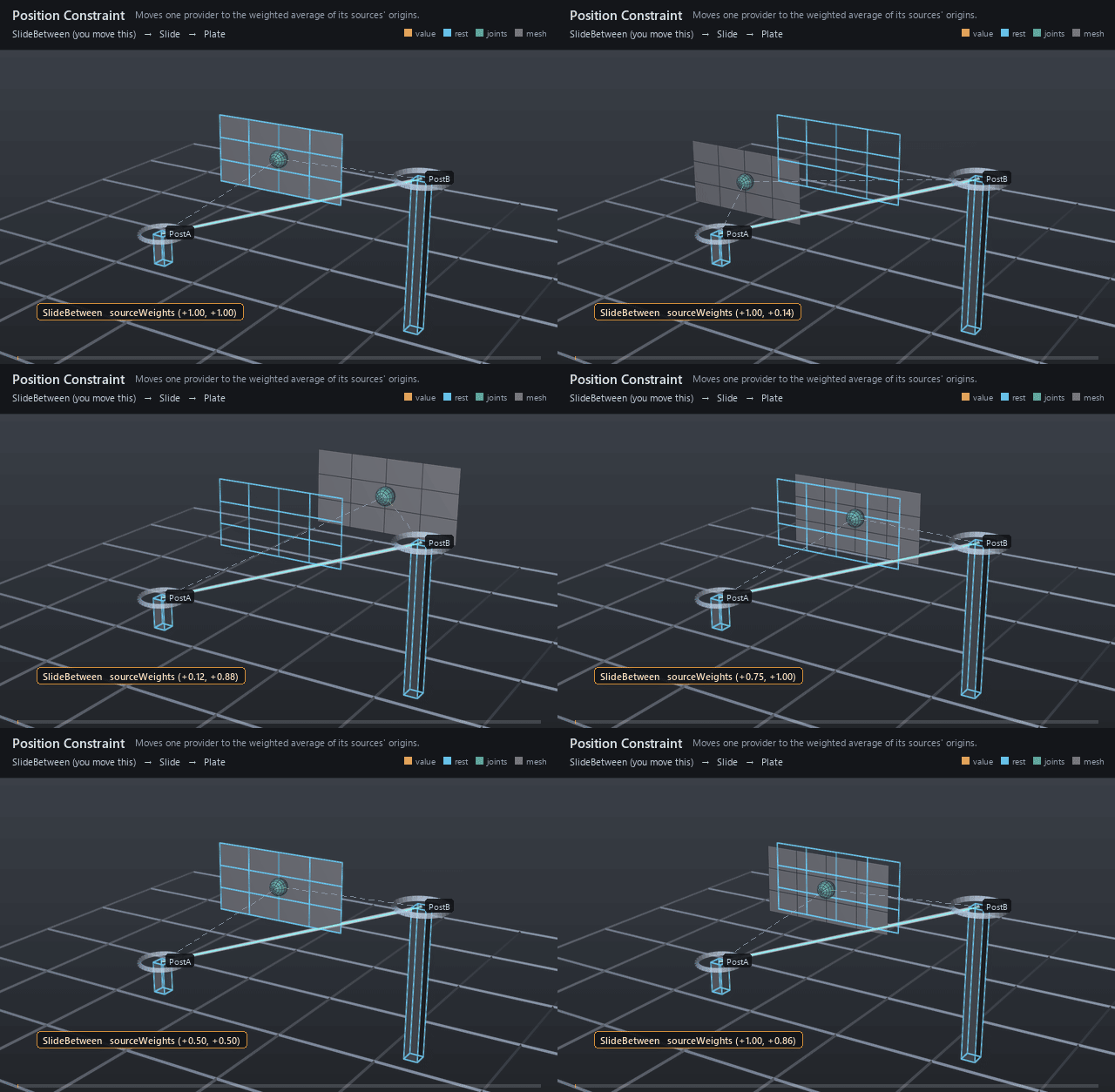
Two posts stand at different heights and a plate hangs between them.
The joint's rest sits exactly at the posts' midpoint, so an even blend lands
on it before the offset, and every bit of motion you see is the blend:
inputs:sourceWeights
starts even at (1, 1) — the blue ghost is that even-blend frame, the plate
parked over the midpoint — then swings to (1, 0), to (0, 1), and back to even,
so the plate departs from its rest in both directions with nothing else in the
rig animated. The pale line between the two post tops is the segment the source
origins define; inputs:translationOffset of (0, 0.9, 0) is the visible gap
between that line and the joint, which is the whole of "maintain offset" here
— there is no such switch.
Open it live with:
Re-render the GIF above with:
Tips
- Weights are ratios, not percentages: the blend divides by their total, so (1, 0) and (5, 0) give the same answer. Only their relative size matters, and nothing needs to sum to one.
- All-zero weights are an exact pass-through, not a collapse to the origin — but a negative weight invalidates the solve instead of being clamped, so keep animated weights at or above zero.
- There is no maintain-offset switch: author
inputs:translationOffset, which is added after the blend.inputs:rotationOffset, theaffectRotation*/affectScale*masks andrigExec:rotationOrderare compile errors here, not silent no-ops — this operator writes translation only.