 Skin Mover
Blends many influences per point in one pass, UsdSkel-style.
| Node type | RigExecSkinMover |
| Example | skin_mover.usda |
On this page:
Overview
Character skinning in a single node: rigExec:influences lists the
joints, and the UsdSkel-shaped rigExec:jointIndices /
rigExec:jointWeights arrays say which of them move each point and by
how much. A stack of matrix movers applies one influence at a time over
the preceding revision, which matches a skinCluster only where a point
has exactly one influence; the skin mover gathers every influence of a
point and blends them together, so shared points bend smoothly instead
of hinging. rigExec:skinningMethod picks the blend: classicLinear
for linear blend skinning, dualQuaternion for the volume-preserving
one.
Flat cut-out artwork binds to a 2D skeleton the same
way: the skeleton's bones are the influences and the weights are
authored arrays like any other skin's. A sphere weight
placed inside each bone, at the midpoint of its segment and stretched along
it with inputs:scaleX, describes the region it owns, and
rigexec.binding.generate_skin_weights(stage, skin_mover) writes the
arrays from those spheres, or from any other volume weight placed inside an
influence: per point, each influence's volume field at the setup pose,
normalised over rigExec:influences. The rows are
authored data, generated once rather than evaluated per frame, so
re-place the spheres and regenerate the rows after moving a rest or
changing a bone's strength; an optional point_indices list regenerates
only those rows.
Multi-influence skinning of an exact native point3f[] points property in ONE pass: every influence's matrix is gathered per point and blended by that point's authored weights, then the result is mixed with the common MoverAPI envelope.
RigExecMatrixMover applies one influence per mover, sequentially, each from the PRECEDING revision. That is exact for a point with a single influence and diverges from a skinCluster everywhere weights blend, so a skinned character needs this mover: the same jointIndices / jointWeights layout UsdSkel uses, with the influence list in rigExec:influences standing in for UsdSkel's joint order.
classicLinear: p' = p + sum_i w_i (T_i p - p) = (1 - sum_i w_i) p + sum_i w_i T_i p. With weights that sum to one this is exactly linear blend skinning; a shortfall keeps the rest point in proportion, so a partially weighted point stays put rather than collapsing toward the origin. dualQuaternion blends the influences' rigid motions as dual quaternions (shortest arc, one normalisation, so a twisted joint keeps its volume instead of candy-wrapping) and their scale and shear linearly in each joint's pre-rotation frame, so squash-and-stretch survives; the same weight shortfall enters that blend as an identity influence, so a partially weighted point is likewise held toward rest.
How it works
The mover is one revision in its target's point chain, so it runs in
the mover-application walk after solving: it reads
every influence's computeMatrix (the rest-to-posed map) at the
rigExecReadPhase declared on rigExec:influences, gathers rigExec:elementSize index/weight
slots per point in point order, and accumulates them — classicLinear
sums w_k T_k p and leaves the weight shortfall 1 - sum w_k on the
rest point, while dualQuaternion splits each influence once per
evaluation into a pre-rotation stretch and a unit dual quaternion,
blends along the shortest arc with one normalisation, and enters the
same shortfall as an identity influence. The resulting points are then
mixed against the incoming revision by the common mover envelope —
inputs:defaultWeight, or a bound rigExec:weightObject — so the
envelope fades the whole skin, not one influence. The layout's element
shape, index range and non-negative finite weights are checked at
compile and again whenever the cached layout is resolved, and the
influence matrices are checked every frame (finite, affine); a mismatch
fails the application rather than skinning a truncated array.
Wiring
| Relationship | Points to | Required |
|---|---|---|
rigExec:influences |
Ordered joints or controls the indices address; at least one, and each must be a catalogued provider. | yes |
rigExec:moves |
The one exact points property to skin. |
yes |
rigExec:jointIndices / rigExec:jointWeights |
Parallel per-point arrays, elementSize slots per point in point order. |
yes |
rigExec:weightObject |
Optional field supplying the envelope instead of inputs:defaultWeight; fades the whole skin. |
no |
Parameters
Common mover envelope
rigExec:moves
Relationship.
Reserved write-set relationship: exact prim/property targets.
inputs:enabled
Type: bool. Default: true.
Shape-preserving enable. Disabled movers pass their preceding revision through unchanged (value-only edit).
inputs:defaultWeight
Type: float. Default: 1.
Normalized common mover envelope in [0, 1]. With no bound rigExec:weightObject it broadcasts over every logical element: zero passes the incoming value through bit-for-bit and one applies the mover's full-strength result. A non-finite value or one outside [0, 1] passes the incoming value through with a diagnostic.
rigExec:weightObject
Relationship.
Optional compatible total weight field, at most one target. When bound, the weight object's values (including its own sparse or constant fallback) supply the common envelope instead of inputs:defaultWeight. Target, domain, and cardinality must match each mover application; an incompatible binding is a compile error. A multi-target mover may bind only a constant operation envelope whose weightTarget is the mover prim itself; that one value broadcasts to every application of the atomic mover.
Node parameters
rigExec:influences
Relationship.
Ordered GfMatrix4d providers (computeMatrix), one per influence. rigExec:jointIndices index this list. Named influences, not joints: rigExec:joints is a solver's output claim, and this mover only reads.
rigExec:jointIndices
Type: int[]. Default: [].
Per-point influence indices into rigExec:influences, rigExec:elementSize entries per point in point order (UsdSkel's primvars:skel:jointIndices layout).
rigExec:jointWeights
Type: float[]. Default: [].
Per-point influence weights parallel to rigExec:jointIndices. Finite and non-negative; not renormalized.
rigExec:elementSize
Type: uniform int. Default: 1.
Influences per point.
rigExec:skinningMethod
Type: uniform token. Default: "classicLinear".
Valid values: classicLinear, dualQuaternion.
Example
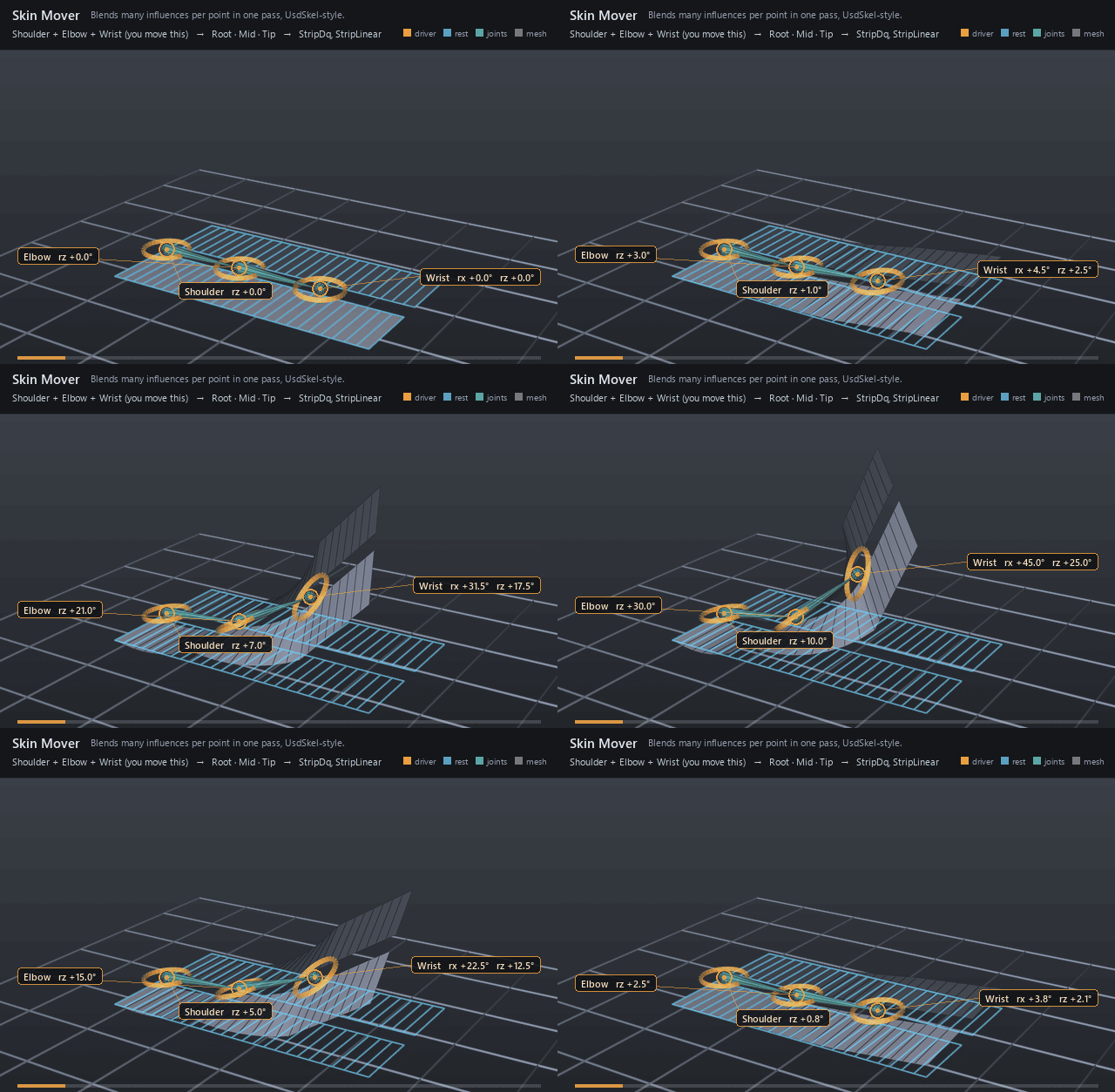
Two identical 24-quad ribbons lie flat in the floor on either side of
one three-joint chain, and each is skinned by ONE skin mover. Both
movers name the same rigExec:influences and carry the same
rigExec:jointIndices / rigExec:jointWeights — two influence slots
per point, ramping 1 → 0 linearly across each span, so the bend draws as
a curve rather than a crease at the joints. The only difference between
them is rigExec:skinningMethod: the bright ribbon is
dualQuaternion, the dim one classicLinear. Where the wrist rolls 45°
the linear ribbon's cross-section pinches from its rest width of 1.500
to 1.386 and its tip falls short of the arc; the dual-quaternion ribbon
holds 1.500 at every column.
Open it live with:
Re-render the GIF above with:
Tips
rigExec:elementSizeis the same for every point: pad a point that needs fewer influences with a zero weight. Weights are never renormalized, and a sum below one holds the point toward its rest position in proportion rather than dragging it to the origin.- Influences must be RigExec provider prims (controls or joints), not arbitrary matrix attributes, and the read phase accepts only
baseorfinal; readfinalso constraints that revise a joint are included. classicLinearhas the SIMD path and is the cheaper blend;dualQuaternionis scalar but keeps volume through twists, which is what a candy-wrapped wrist or the pinch at a bent elbow is missing.