 ML Mover
A neural morph deformer: a small network maps the pose to morph weights.
| Node type | RigExecMlMover |
| Example | ml_mover.usda |
On this page:
Overview
The ML mover is a learned corrective. A multilayer perceptron
reads the rig's pose -- each driver joint's local rotation from rest as a
quaternion, then any number of float properties -- and produces one weight per
RigExecMlOutput child. Those weights drive sparse morph targets added to the
moved points, so a trained network can supply the folds and bulges a linear
skin cannot. The network is Epic Games RigLogic's machine-learned behavior
(dense layers with linear, relu, leaky relu, tanh or sigmoid activations, and
its region mask), ported from OpenRigLogic (MIT, RigLogic 13.5.0); see
algorithm references and
RigLogic behaviours for what was ported and what
was added.
A neural morph deformer: a multilayer perceptron maps the rig's pose to one weight per RigExecMlOutput child, and those weights drive sparse morph targets added to the moved points.
The network is RigLogic's (Epic Games OpenRigLogic, see docs/references.md): dense layers, each a row-major weight matrix with one row per output unit, a bias, and a linear, relu, leakyRelu, tanh or sigmoid activation. Its input row is each rigExec:driver's local rotation from rest as (x, y, z, w) on the w >= 0 hemisphere -- measured exactly as a pose interpolator measures its driver -- followed by each rigExec:driverAttributes value as read.
Two halves, one prim. The network publishes each output's weight as that child's outputs:weight, which anything can read the way it reads a RigExecPose weight. The mover half is a blend-shape revision of the points it moves: its rigExec:blendInputs are ordinary RigExecBlendInput channels, normally one per output with inputs:weight connected to it and one RigExecBlendSample naming a UsdSkelBlendShape, so the morphs are sparse offsets and the common MoverAPI envelope applies to their sum.
How it works
One prim, two halves, both in the shared operation graph. The
network runs in the pose domain beside pose interpolators: it reads each
driver's final and rest frames (and its nearest joint or control ancestor's),
forms (restLocal^-1 * local) per driver exactly as an interpolator does,
puts each rotation on the w >= 0 hemisphere as (x, y, z, w), appends the
numeric inputs, normalizes them by rigExec:inputMean/rigExec:inputScale,
and evaluates the layers (libs/rigExecMath/mlpKernel.h). inputs:mask at
exactly zero publishes rigExec:outputDefaults without running the network;
any other mask multiplies every output. Each output is published as its
child's outputs:weight. The mover half is a blend-shape revision of
rigExec:moves: its rigExec:blendInputs connect to those outputs and name
UsdSkelBlendShape samples, so the morphs are sparse offsets and the common
mover envelope scales their sum. The frame cache and the .rigexec runtime
run the same kernel and the same blend revision.
Wiring
| Relationship | Points to | Required |
|---|---|---|
rigExec:moves |
One native mesh points property. | yes |
rigExec:driver |
Joints or controls, four inputs each, in order. | no |
rigExec:driverAttributes |
Float or double properties, one input each, after the joints. | no |
RigExecMlOutput children |
One per network output, in namespace order. | yes |
rigExec:blendInputs |
Blend channels whose inputs:weight connects to an output, each with a RigExecBlendSample naming a UsdSkelBlendShape. |
yes |
Parameters
Common mover envelope
rigExec:moves
Relationship.
Reserved write-set relationship: exact prim/property targets.
inputs:enabled
Type: bool. Default: true.
Shape-preserving enable. Disabled movers pass their preceding revision through unchanged (value-only edit).
inputs:defaultWeight
Type: float. Default: 1.
Normalized common mover envelope in [0, 1]. With no bound rigExec:weightObject it broadcasts over every logical element: zero passes the incoming value through bit-for-bit and one applies the mover's full-strength result. A non-finite value or one outside [0, 1] passes the incoming value through with a diagnostic.
rigExec:weightObject
Relationship.
Optional compatible total weight field, at most one target. When bound, the weight object's values (including its own sparse or constant fallback) supply the common envelope instead of inputs:defaultWeight. Target, domain, and cardinality must match each mover application; an incompatible binding is a compile error. A multi-target mover may bind only a constant operation envelope whose weightTarget is the mover prim itself; that one value broadcasts to every application of the atomic mover.
Node parameters
rigExec:driver
Relationship.
Frame drivers, in input order: joints or controls, each contributing four values, its local rotation relative to its rest against its nearest joint or control ancestor.
rigExec:driverAttributes
Relationship.
Numeric drivers, in input order after the frame drivers: float or double properties, any number, each one value.
rigExec:layerSizes
Type: uniform int[]. Default: [].
The width of each layer's output, first layer first.
rigExec:layerActivations
Type: uniform int[]. Default: [].
Each layer's activation, RigLogic's ActivationFunction codes: 0 linear, 1 relu, 2 leakyRelu, 3 tanh, 4 sigmoid.
rigExec:layerAlphas
Type: uniform float[]. Default: [].
Each layer's leakyRelu slope below zero, or empty. Read only by leakyRelu layers.
rigExec:weights
Type: uniform float[]. Default: [].
Every layer's weights, layer after layer, each row-major with one row per output unit: output r reads inputs weights[r * inputs .. (r + 1) * inputs).
rigExec:biases
Type: uniform float[]. Default: [].
Every layer's biases, layer after layer.
rigExec:inputMean
Type: uniform float[]. Default: [].
Optional per-input normalization: each input becomes (x - inputMean) * inputScale before the first layer. Empty skips it.
rigExec:inputScale
Type: uniform float[]. Default: [].
See rigExec:inputMean.
rigExec:outputDefaults
Type: uniform float[]. Default: [].
What each output publishes while inputs:mask is exactly zero, RigLogic's default values. Empty is zero.
inputs:mask
Type: float. Default: 1.
RigLogic's region mask. Exactly zero publishes the defaults without running the network; anything else runs it and multiplies every output by the mask.
rigExec:blendInputs
Relationship.
The blend channels this mover applies, normally one per output, connected to it.
rigExec:deltaSpace
Type: uniform token. Default: "target".
Valid values: target, surfaceFrame.
As on RigExecBlendShapeMover.
Example
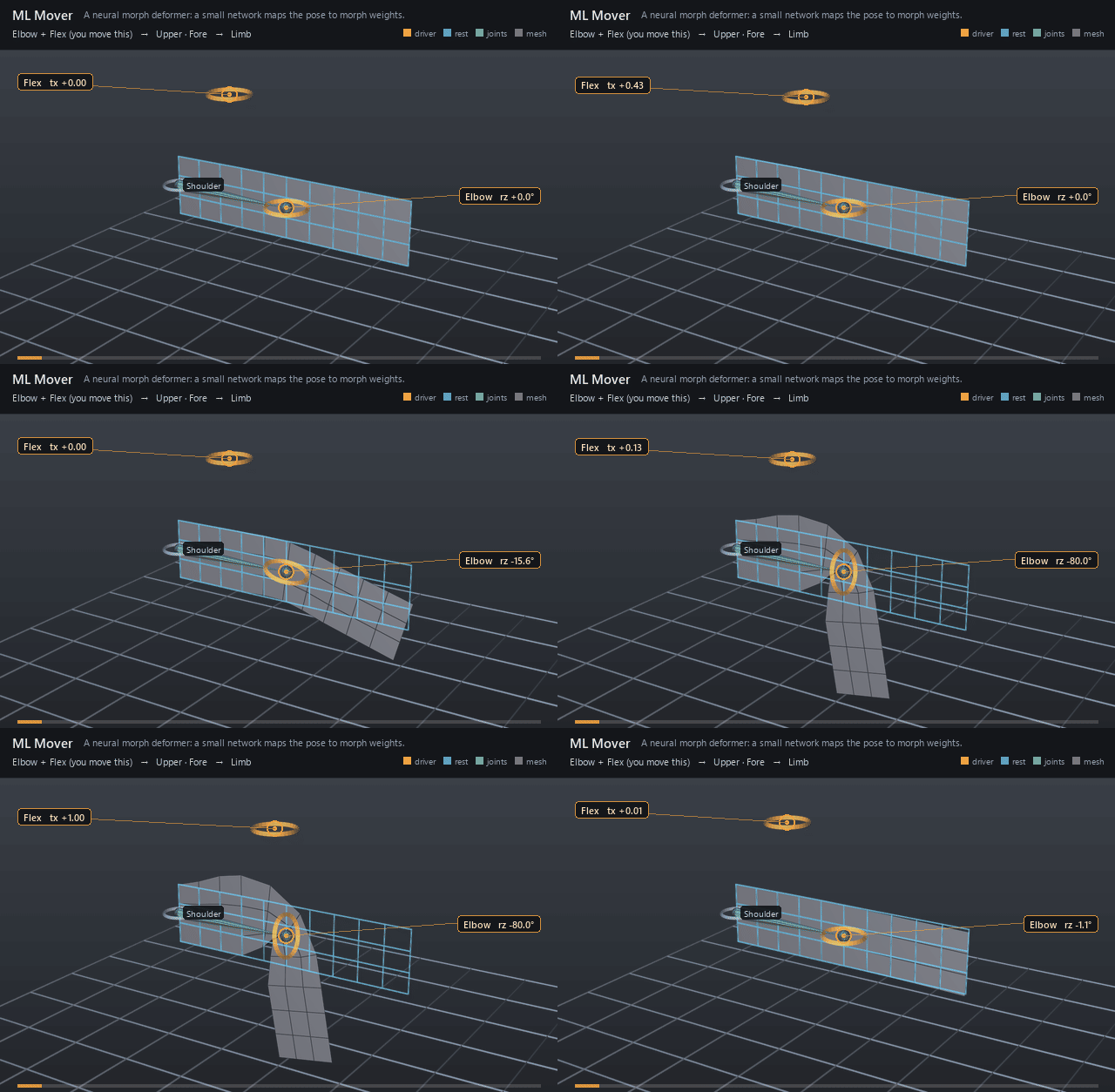
A two-joint arm is skinned to a 30-quad strip, and a Flex slider's
tx stands for muscle tension from 0 to 1. The ML mover Muscles is the arm's
corrective: its network reads the Fore joint's local rotation from rest (four
inputs) and Flex.avars:tx (a fifth) through a tanh layer of three units
into two sigmoid outputs, bicep and crease. Each output's
outputs:weight is connected to a blend channel whose sample is a sparse
UsdSkelBlendShape. The weights are set by hand so the behaviour reads clearly
(a trained network writes the same arrays): flexing the straight arm lifts
bicep to 0.44; closing the elbow to 80 degrees lifts it to 0.73 and fires
crease late, at 0.98; flexing while bent takes bicep to 0.94. The two
skin movers are nested under the ML mover, so the morphs are added to the
skinned points. AddMorph in the builder authors an output, its blend input
and its sample in one call.
Open it live with:
Re-render the GIF above with:
Tips
- Layer weights are row-major with one row per output unit, every layer's weights first and then every layer's biases, as RigLogic stores them.
- The rotation inputs are expressed in each driver's own rest frame. A network trained on another convention can be folded into its first layer: a fixed per-driver rotation of the quaternion is linear.
- The network, its normalization and its output count are compiled rig identity: an edit recompiles. The mask and the numeric inputs are per-frame inputs.
- A network whose output count differs from its
RigExecMlOutputchildren is set aside at compile.