 Harmonics Constraint
Secondary motion: overshoot, lag and jiggle of one joint or control from the frames before the current one.
| Node type | RigExecHarmonicsConstraint |
| Example | harmonics_constraint.usda |
On this page:
Overview
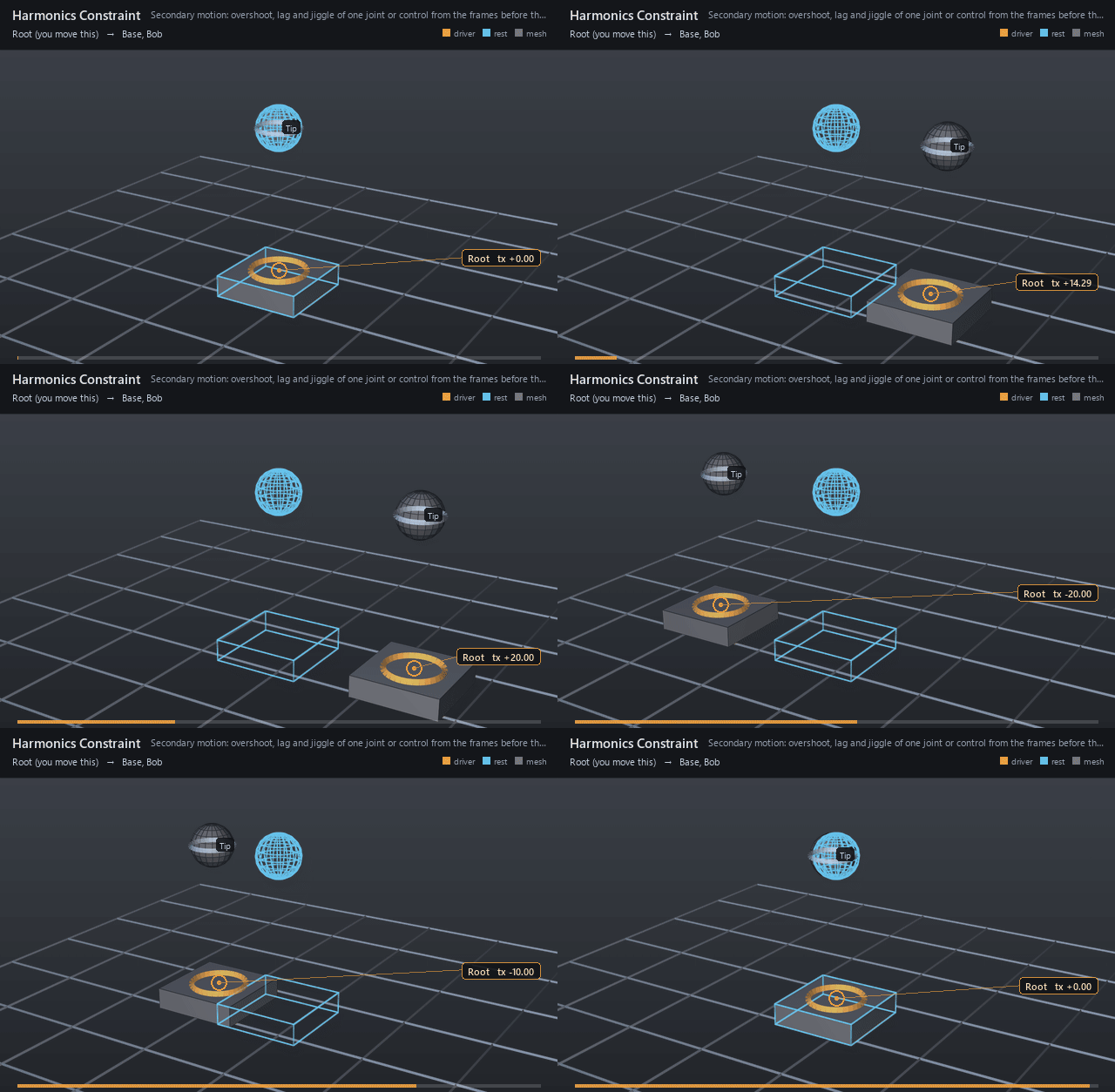
Adds follow-through to one joint or control. Each change
in the target's velocity over the last few frames rings as a damped sine, and
the rings still sounding are added to the target's translation. A tail tip
overshoots when the body stops, an antenna bobs after a hop, a belly jiggles
after a step. The result depends only on the frames in a fixed window before
the current one, so scrubbing, playback, a background cache and a .rigexec
reader all agree. While a control is dragged, the earlier frames are the
authored animation and the current frame is the drag, so the target is held
back against the drag; the ring plays when time moves.
See Secondary motion and cloth for how the
window is evaluated, and algorithm references for the
method's source.
Secondary motion for one joint or control: overshoot, lag and jiggle from the way it moved over the frames before the current one.
The target's incoming position is measured in rigExec:space (the rig root when none is named) at the current frame and at each earlier frame of a fixed window. Every earlier frame's acceleration rings as a damped sine, and the sum of the rings still sounding is added to the target's translation, scaled by the MoverAPI envelope. The window is rigExec:waves * rigExec:waveLength / rigExec:frequency frames (all three above zero and the window at most 4094 frames, or the compile fails), so the result depends only on the frames in it: scrubbing, playback and a background cache all agree. While a control is dragged the earlier frames are the authored animation and the current frame is the dragged pose, so the ring answers the drag.
The method is the harmonic solver of BlurHarmonics (docs/references.md); see docs/concepts/secondary-motion.md.
How it works
The constraint reads its target's incoming position, measured
in rigExec:space (the rig root when none is named), at the current frame and
at each of the rigExec:waves * rigExec:waveLength / rigExec:frequency frames
before it. Those earlier frames are generations of the same compiled graph at
those times, run only as far as the target's inputs reach, and they read the
authored stage. From the positions the kernel (harmonicsKernel.h) takes each
frame's acceleration and adds its ring: a sine of waveLength / frequency
frames per period under an exponential envelope set by inputs:decay, ending
at inputs:termination of the amplitude. rigExec:matchVelocity scales the
ring so an impulse rings with the velocity change that caused it;
inputs:amplitude and inputs:axisAmplitude scale it, per axis of the space.
The sum is added to the target's translation and blended by the common mover
envelope. Motion of the space itself does not ring, so a jiggle measured in
the hips follows a walk and answers only the motion relative to them. A
.rigexec reader keeps the same window of its own frames: a host pushes each
frame it plays, or replays the frames before a jump.
Wiring
| Relationship | Points to | Required |
|---|---|---|
rigExec:moves |
The one joint or control whose translation rings. | yes |
rigExec:space |
A control or joint the motion is measured in. | no |
Parameters
Common mover envelope
rigExec:moves
Relationship.
Reserved write-set relationship: exact prim/property targets.
inputs:enabled
Type: bool. Default: true.
Shape-preserving enable. Disabled movers pass their preceding revision through unchanged (value-only edit).
inputs:defaultWeight
Type: float. Default: 1.
Normalized common mover envelope in [0, 1]. With no bound rigExec:weightObject it broadcasts over every logical element: zero passes the incoming value through bit-for-bit and one applies the mover's full-strength result. A non-finite value or one outside [0, 1] passes the incoming value through with a diagnostic.
rigExec:weightObject
Relationship.
Optional compatible total weight field, at most one target. When bound, the weight object's values (including its own sparse or constant fallback) supply the common envelope instead of inputs:defaultWeight. Target, domain, and cardinality must match each mover application; an incompatible binding is a compile error. A multi-target mover may bind only a constant operation envelope whose weightTarget is the mover prim itself; that one value broadcasts to every application of the atomic mover.
Constraint base
rigExec:locked
Type: uniform bool. Default: false.
Authoring lock metadata for application interchange. Evaluation remains active while locked; use RigExecMoverAPI inputs:enabled or inputs:defaultWeight to disable or blend the operation.
inputs:affectTranslationX
Type: bool. Default: true.
Per-axis translation mask. Ignored groups are a compile error.
inputs:affectTranslationY
Type: bool. Default: true.
inputs:affectTranslationZ
Type: bool. Default: true.
inputs:affectRotationX
Type: bool. Default: true.
Per-axis rotation mask. Ignored groups are a compile error.
inputs:affectRotationY
Type: bool. Default: true.
inputs:affectRotationZ
Type: bool. Default: true.
inputs:affectScaleX
Type: bool. Default: true.
Per-axis scale mask. Ignored groups are a compile error. RigExecParentConstraint overrides the default to false to match the FBX runtime, which leaves scale off unless it is asked for.
inputs:affectScaleY
Type: bool. Default: true.
inputs:affectScaleZ
Type: bool. Default: true.
inputs:translationOffset
Type: double3. Default: (0, 0, 0).
Additive translation offset applied after the source blend.
inputs:rotationOffset
Type: double3. Default: (0, 0, 0).
Additive Euler rotation offset in degrees, applied after the blend.
inputs:scaleOffset
Type: double3. Default: (0, 0, 0).
ADDITIVE scale offset applied after the blend, which is why its identity is (0, 0, 0) and not (1, 1, 1): the kernel computes blendedScale + offset. A multiplicative offset would be a different operator, not a different default.
rigExec:rotationOrder
Type: uniform token. Default: "XYZ".
Valid values: XYZ, XZY, YXZ, YZX, ZXY, ZYX.
Euler order for the operators that compose a rotation. Authoring it on one that does not is a compile error.
Node parameters
rigExec:space
Relationship.
Optional single RigExecControl or RigExecJoint whose frame the motion is measured in. Motion of the space itself does not ring: a jiggle measured in the hips follows a walk and answers only the motion relative to them.
rigExec:waves
Type: uniform double. Default: 5.
How many oscillations one impulse rings for.
rigExec:waveLength
Type: uniform double. Default: 5.
Frames per oscillation.
rigExec:frequency
Type: uniform double. Default: 1.
Phase frames one frame advances. Above 1 the ring is faster and the window shorter; below 1 it is slower and longer.
rigExec:ignoreFirstFrame
Type: uniform bool. Default: true.
When the history is shorter than the window (a .rigexec reader's first frames), drop the jolt of starting to move from rest.
rigExec:matchVelocity
Type: uniform bool. Default: true.
Scale the amplitude by waveLength / (2 pi), so an impulse rings with the velocity change that caused it. Off uses inputs:amplitude as the ring's amplitude.
inputs:amplitude
Type: double. Default: 1.
Overall multiplier on the ring.
inputs:axisAmplitude
Type: double3. Default: (1, 1, 1).
Per-axis multipliers, along the axes of rigExec:space.
inputs:decay
Type: double. Default: 3.
How fast a ring dies away. The envelope falls from 1 at the impulse to inputs:termination as the ring ends; at 0 it falls linearly.
inputs:termination
Type: double. Default: 0.
The fraction of the amplitude a ring has left when it ends.
Example
harmonics_constraint.usda puts a bob above a base that dashes
left and right. The Tip control rides the Root control; the constraint
rings Tip with four waves of six frames each, so the bob swings past the base
at every stop and settles within a second. Dragging Root in usdview holds
the bob back against the drag, further the further it goes, since the earlier
frames stay the authored ones; the ring itself plays when time moves.
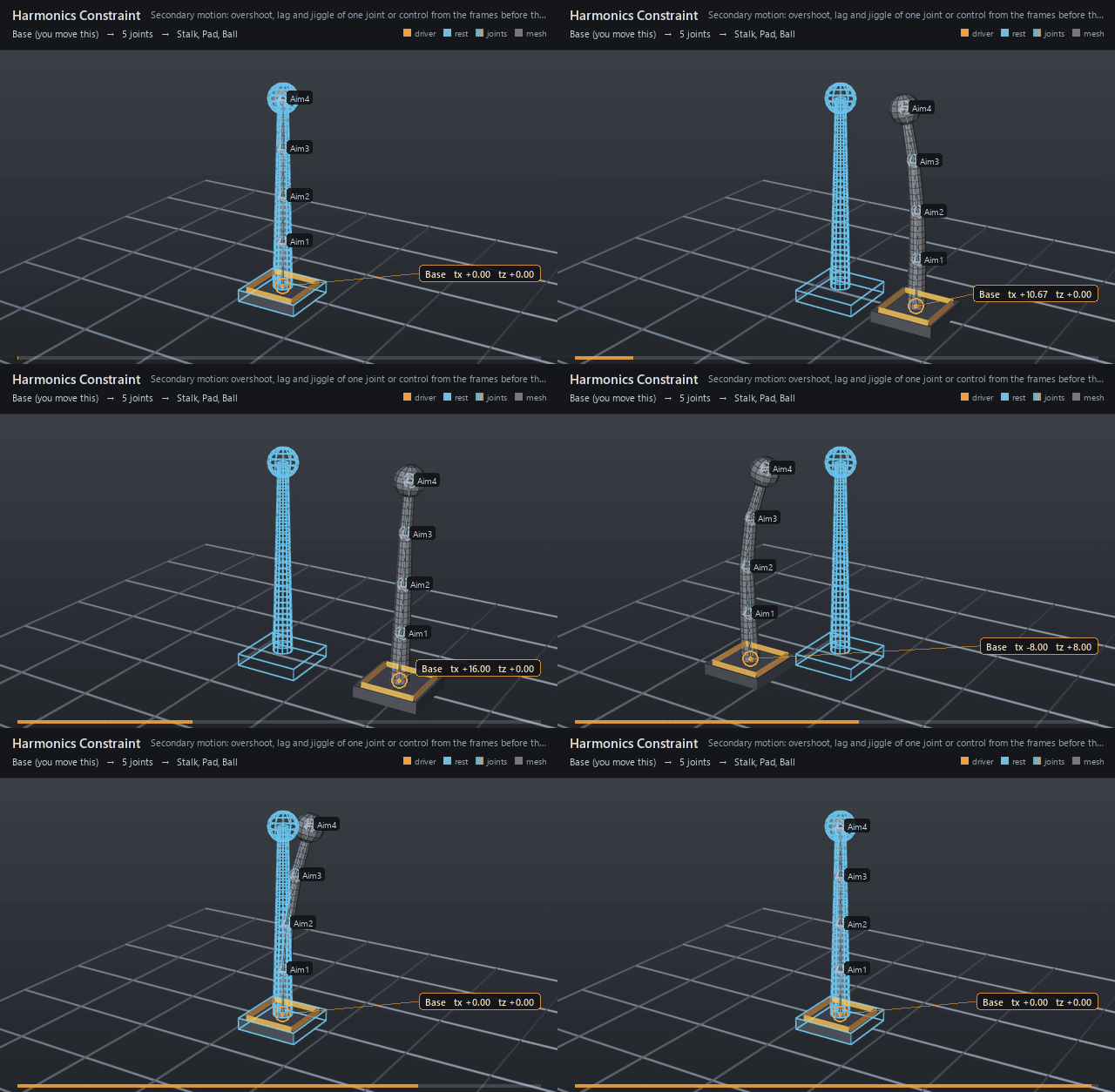
examples/19_HarmonicsChain.usda turns rings into rotation down a chain: each
segment of a four-joint stalk aims at a target control one segment higher,
and a harmonics constraint rings each target, larger and slower up the stalk.
The jiggles sit below the aim constraints in the stack, and the aims run from
the base up, so the stalk leans behind each dash, whips past the stop and
settles with its segment lengths unchanged.
Open it live with:
Re-render the GIFs on this page with:
Tips
- Window length is waves times waveLength over frequency: longer rings read more earlier frames.
- To ring a chain's rotation, ring aim targets and aim each joint at the next one up; keep the jiggles below the aims in the stack.
- Measure a jiggle in the part it hangs from (rigExec:space) so that part's own motion is not repeated.
- Use inputs:axisAmplitude to keep a ring in one plane, for a pendulum or a door.
- The first frames of a .rigexec reader have less history; rigExec:ignoreFirstFrame drops the jolt of starting from rest.