 Parent Constraint
Carries a target with its sources — position and rotation — under a per-source offset; weight attaches and releases.
| Node type | RigExecParentConstraint |
| Example | parent_constraint.usda |
On this page:
Overview
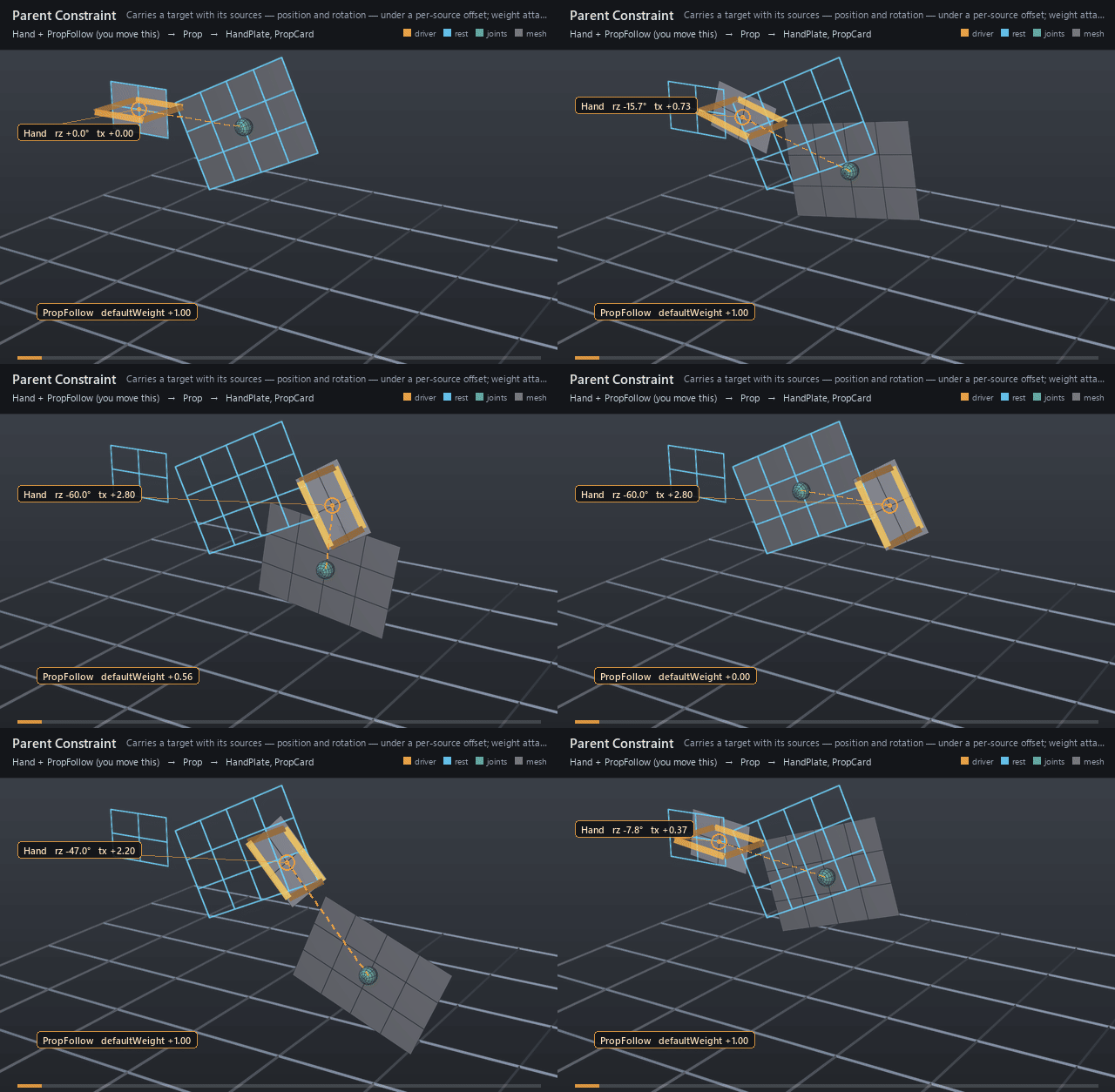
FBX-style parenting expressed as a constraint rather than as namespace
nesting: the prim named by rigExec:moves is carried by the blended
rigExec:sources, keeping the offset authored for each source. It is the
one constraint that writes all three channel groups, and the one whose
scale group is off by default, matching the FBX runtime — a parented
prop inherits where its parent is and which way it faces, not how big it
is. Because it is an ordinary mover, inputs:defaultWeight is the
attach/release channel: key it down and the prop settles back into its own
space.
FBX-style parent constraint. Translation and rotation are enabled on every axis by default. Scale is disabled on every axis by default to match the FBX runtime default. Offset arrays are parallel to the inherited ordered rigExec:sources relationship.
An optional rigExec:space relationship, not declared by this schema, works as on RigExecRotationConstraint: with two or more sources, the mean of their Euler angles is taken in that provider's space.
How it works
In the pose phase the constraint resolves each entry of the ordered
rigExec:sources to that source's current revision, composes the matching
inputs:translationOffsets[i] / inputs:rotationOffsets[i] entry before
the source transform (targetMatrix = offset * source), and accumulates a
weighted average of the resulting translations and scales plus a
shortest-arc Euler average of the rotations, anchored on the first
contributing source and read in rigExec:rotationOrder. That candidate is
then written per axis through the three inputs:affect* mask triples and
blended over the target's incoming frame by the common mover envelope, so
the single rigExec:moves target is revised in place and anything that reads
that provider afterwards -- a skinning mover whose input carries
rigExecReadPhase = "final", for instance -- sees the parented
result. A zero envelope is an exact pass-through: the target keeps whatever
posed it before the constraint ran.
Wiring
| Relationship | Points to | Required |
|---|---|---|
rigExec:sources |
Ordered transform providers that carry the target; order is shared with every parallel array. | yes |
rigExec:moves |
The one transform provider this constraint revises (pose phase). | yes |
rigExec:weightObject |
Optional weight field supplying the attach envelope instead of inputs:defaultWeight. |
no |
inputs:translationOffsets |
Per-source translation offsets, parallel to rigExec:sources (empty = zero). |
no |
inputs:rotationOffsets |
Per-source Euler offsets in degrees, parallel to rigExec:sources (empty = zero). |
no |
inputs:sourceWeights |
Per-source blend weights (empty = every source at full weight). | no |
Parameters
Common mover envelope
rigExec:moves
Relationship.
Reserved write-set relationship: exact prim/property targets.
inputs:enabled
Type: bool. Default: true.
Shape-preserving enable. Disabled movers pass their preceding revision through unchanged (value-only edit).
inputs:defaultWeight
Type: float. Default: 1.
Normalized common mover envelope in [0, 1]. With no bound rigExec:weightObject it broadcasts over every logical element: zero passes the incoming value through bit-for-bit and one applies the mover's full-strength result. A non-finite value or one outside [0, 1] passes the incoming value through with a diagnostic.
rigExec:weightObject
Relationship.
Optional compatible total weight field, at most one target. When bound, the weight object's values (including its own sparse or constant fallback) supply the common envelope instead of inputs:defaultWeight. Target, domain, and cardinality must match each mover application; an incompatible binding is a compile error. A multi-target mover may bind only a constant operation envelope whose weightTarget is the mover prim itself; that one value broadcasts to every application of the atomic mover.
Constraint base
rigExec:locked
Type: uniform bool. Default: false.
Authoring lock metadata for application interchange. Evaluation remains active while locked; use RigExecMoverAPI inputs:enabled or inputs:defaultWeight to disable or blend the operation.
inputs:affectTranslationX
Type: bool. Default: true.
Per-axis translation mask. Ignored groups are a compile error.
inputs:affectTranslationY
Type: bool. Default: true.
inputs:affectTranslationZ
Type: bool. Default: true.
inputs:affectRotationX
Type: bool. Default: true.
Per-axis rotation mask. Ignored groups are a compile error.
inputs:affectRotationY
Type: bool. Default: true.
inputs:affectRotationZ
Type: bool. Default: true.
inputs:affectScaleX
Type: bool. Default: true.
Per-axis scale mask. Ignored groups are a compile error. RigExecParentConstraint overrides the default to false to match the FBX runtime, which leaves scale off unless it is asked for.
inputs:affectScaleY
Type: bool. Default: true.
inputs:affectScaleZ
Type: bool. Default: true.
inputs:translationOffset
Type: double3. Default: (0, 0, 0).
Additive translation offset applied after the source blend.
inputs:rotationOffset
Type: double3. Default: (0, 0, 0).
Additive Euler rotation offset in degrees, applied after the blend.
inputs:scaleOffset
Type: double3. Default: (0, 0, 0).
ADDITIVE scale offset applied after the blend, which is why its identity is (0, 0, 0) and not (1, 1, 1): the kernel computes blendedScale + offset. A multiplicative offset would be a different operator, not a different default.
rigExec:rotationOrder
Type: uniform token. Default: "XYZ".
Valid values: XYZ, XZY, YXZ, YZX, ZXY, ZYX.
Euler order for the operators that compose a rotation. Authoring it on one that does not is a compile error.
Ordered sources
rigExec:sources
Relationship.
Ordered transform sources. Order is preserved through composition because it identifies entries in every parallel source array.
inputs:sourceWeights
Type: float[]. Default: [].
Per-source weights parallel to rigExec:sources. An empty array gives every source equal, full weight. A non-empty array must have exactly one entry per source. Weights are relative: the sources mix by weight over their total, and each must be finite and not negative.
Node parameters
inputs:affectScaleX
Type: bool. Default: false.
inputs:affectScaleY
Type: bool. Default: false.
inputs:affectScaleZ
Type: bool. Default: false.
inputs:translationOffsets
Type: double3[]. Default: [].
Per-source translation offsets parallel to rigExec:sources.
inputs:rotationOffsets
Type: double3[]. Default: [].
Per-source Euler rotation offsets parallel to rigExec:sources.
rigExec:blendShear
Type: uniform bool. Default: false.
With all three inputs:affectScale axes on, blend the sources' SHEAR as well as their scale. Shear lives in the same linear block as scale, so a constraint that replaces scale from a clean source can still leave behind a shear the input inherited -- a chain stretched by a spline IK with volume preservation carries one down to every child. Off (the default) keeps the input's shear, which is the FBX behaviour. Ignored when any scale axis is masked off: shear mixes two axes at a time, so a partial mask has no meaningful share of it.
Example
A Prop joint is parented to the Hand control with a
(1.6, 0, 0) translation offset and a 25-degree Z rotation offset, and a flat
card is skinned rigidly to that joint, so the card rides out and rotates with
the hand while holding that exact distance and tilt.
Mid-shot inputs:defaultWeight fades 1 → 0 and the card slides back to its
own rest space while the hand stays out; the weight returns to 1 and the
card re-attaches at the same offset it left with, then the hand carries it
home.
Open it live with:
Re-render the GIF above with:
Tips
- Scale is off on every axis by default — this is the only constraint that overrides the base class's all-on default, to match the FBX runtime — so a parented prop keeps its own scale until you author
inputs:affectScale*. - The offsets are per-source arrays. Authoring the scalar
inputs:translationOffset/inputs:rotationOffset/inputs:scaleOffsetinherited from the constraint base is a compile error here, because this operator composes the arrays instead. inputs:defaultWeightis re-read every frame, so keying it is the attach/release channel; at 0 the constraint is a bit-for-bit pass-through and the target falls back to whatever posed it earlier.