 Static Weight
A painted, time-invariant weight field over moved points.
| Node type | RigExecStaticWeight |
| Example | static_weight.usda |
On this page:
Overview
The paint layer of rigging: one scalar per moved point, authored once
and held for the shot. Constant representation broadcasts a single value
to a whole target; dense lists every element; sparse lists painted
indices over a default. Bound through a mover's rigExec:weightObject,
it scales that mover's effect per point.
Time-invariant constant, dense, or sparse authored weight field; every target element resolves to an explicit value or rigExec:defaultWeight.
How it works
The field resolves inside the mover walk, in the pass that assembles
the revision consuming it: every target element gets an explicit value
(or the sparse default), and that array is published as the mover's
envelope in place of inputs:defaultWeight for that application. The
fields are time-invariant by contract — time samples or connections on
rigExec:values, rigExec:indices, rigExec:defaultWeight,
rigExec:representation, or rigExec:rangePolicy make compile set aside
the mover that binds the field — and strict rejects a value outside
[0, 1] where clamp bounds it.
Wiring
| Relationship | Points to | Required |
|---|---|---|
rigExec:weightTarget |
Exact points property this field covers; must match the target of the mover that binds it. | yes |
| (bound by) | A mover's rigExec:weightObject applies this field. |
- |
Parameters
Weight field
guide:weightDisplay
Type: uniform token. Default: "tint".
Valid values: tint, heatmap, bands.
Selected influence overlay: tint blends gray to red; heatmap interpolates dark blue, blue, teal, yellow and red at weights 0, .25, .5, .75 and 1. bands assigns five colors in .2-wide bins. Colors use resolved vertex weights, clamped to [0,1] for display; faces interpolate them, so bands are approximate on coarse meshes. Does not change weights, materials or opacity on the source stage.
rigExec:weightTarget
Relationship.
Canonical prim or exact property carrying the weighted domain. For a constant envelope over an atomic multi-target mover, this is the mover prim itself.
rigExec:representation
Type: uniform token. Default: "constant".
Valid values: constant, dense, sparse.
rigExec:rangePolicy
Type: uniform token. Default: "strict".
Valid values: strict, clamp.
Node parameters
rigExec:values
Type: uniform float[]. Default: [].
rigExec:indices
Type: uniform int[]. Default: [].
rigExec:defaultWeight
Type: uniform float. Default: 0.
Example
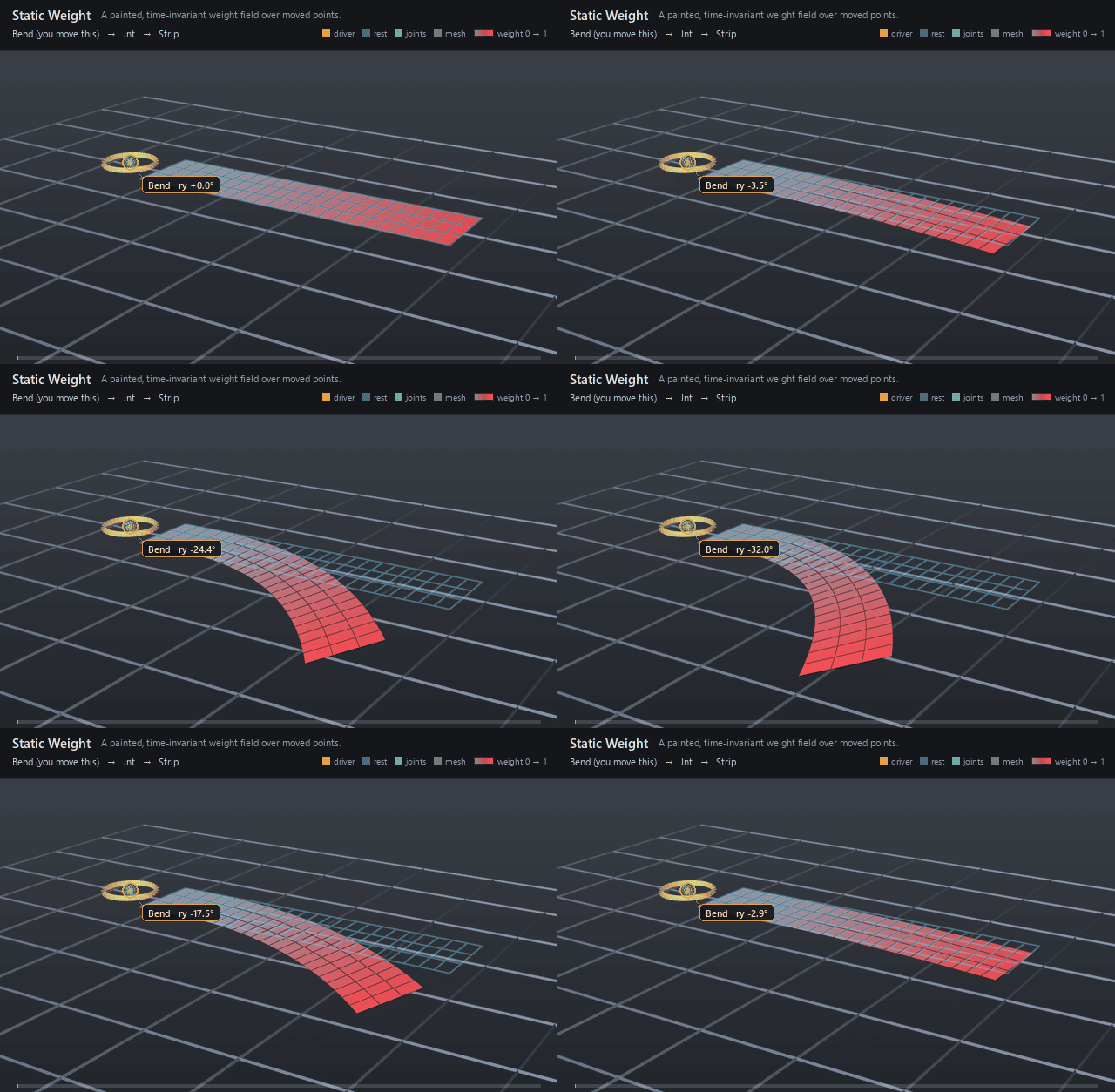
One joint yaws 0 → −32 → 0 degrees while a dense field over a 24 × 4 strip holds the root columns at 0 and ramps to 1 at the tip, so the bend grows along the strip and the root never leaves its rest position — paint, not animation, shaping the deformation. The sweep stays in the ground plane, so the strip keeps its face to the camera and the ramp reads the same at the extreme as it does at rest. The docs renderer tints the strip by the field the mover actually consumed, grey at weight 0 and red at weight 1, so the fixed ramp is visible while the pose swings through it.
Open it live with:
Re-render the GIF above with:
Tips
- Dense suits small ordered targets; sparse suits hero meshes where most verts sit at the default.
- A dense field must author exactly one value per target element and leave
rigExec:defaultWeightat 0 — the canonical encoding — or compile sets aside the mover that binds it rather than padding. - A constant field of 1.0 is the rigid-attachment idiom: full follow, no paint.