 Joint
A posed output of the rig: solvers write it, movers read it.
| Node type | RigExecJoint |
| Example | joint.usda |
On this page:
Overview
A joint is where solved posing becomes readable data.
rigExec:joints is an ordered write and not an exclusive claim: any number of
aggregate solvers may name one joint, and any number of pose constraints may
name it on rigExec:moves. All of them are steps of one kind in ONE
hierarchical stack, ordered by the composed namespace of the whole rig — the
bottom sibling first — and by nothing else. A constraint that sits BELOW a
solver runs before it and feeds it: the frame it leaves becomes that solver's
rest reference. A constraint ABOVE it revises the solver's output, which is the
classic shape and the one you get by putting Solvers at the bottom of the
rig. Joints nest in the namespace to form the hierarchy, and
usdview draws each joint as a guide sphere with a cone to every nested
child.
The joint of an armature-based rig, modeled on OpenExec's IrJointScope: a RigExecXformable specialized so guides can be drawn (a sphere at the posed origin and one cone to each nested child joint, purpose guide). Unlike IrJointScope it adds avars:sx/sy/sz and sizes its guides with guide:radius rather than guide:length. Hierarchy is namespace nesting (a child joint is authored inside its parent joint), and guide links derive directly from the evaluated parent and child origins.
How it works
The compiler builds one chain per joint out of every step that
writes it — the solvers that name it and the constraints that move it — in the
rig's hierarchical order, and the pose phase runs that chain. Steps
of different chains are ordered only where one reads a frame the other
writes, so unrelated joints may be posed in parallel. A solver
extracts the joint's element from its frame array and REPLACES whatever stood
there, measuring the joint from the frame the preceding steps left; a
constraint reads that same incoming frame and writes a revised one over it. A
joint no solver names is still evaluated — it follows its namespace parent's
posed space with its own rest offset and avars — and a joint with no step
before a solver hands that solver its authored rest:space rest, which is why
constraints that all sit above a rig's solvers never change what those
solvers measure. A mover reads the base frame — the joint after the LAST SOLVER in the
chain — unless it asks for final, which is the top of the chain, or names a
prim, which is the joint as of when the walk finished with it.
Wiring
| Relationship | Points to | Required |
|---|---|---|
| (posed by) | Any number of solvers' rigExec:joints name this joint; the writes stack in hierarchical order and the last one supplies its base frame. |
- |
| (revised by) | Any number of pose constraints name this joint on rigExec:moves. They occupy the SAME hierarchical stack as the solvers: one above a solver revises its output, one below feeds it. |
- |
Parameters
Transform provider
rest:tx
Type: double. Default: 0.
rest:ty
Type: double. Default: 0.
rest:tz
Type: double. Default: 0.
rest:rx
Type: double. Default: 0.
rest:ry
Type: double. Default: 0.
rest:rz
Type: double. Default: 0.
rest:space
Type: matrix4d. Default: ( (1, 0, 0, 0), (0, 1, 0, 0), (0, 0, 1, 0), (0, 0, 0, 1) ).
Bind transform relative to the namespace frame provider's rest frame, applied after the rest:tx/ty/tz/rx/ry/rz offsets; always orthonormalized. A plain Xformable between the provider and that frame provider is composed in after it. A provider with no RigExec ancestor and no such Xformable resolves against identity, so its rest:space is its local-to-world bind transform.
default:tx
Type: double. Default: 0.
default:ty
Type: double. Default: 0.
default:tz
Type: double. Default: 0.
default:rx
Type: double. Default: 0.
default:ry
Type: double. Default: 0.
default:rz
Type: double. Default: 0.
default:space
Type: matrix4d. Default: ( (1, 0, 0, 0), (0, 1, 0, 0), (0, 0, 1, 0), (0, 0, 0, 1) ).
Local-to-world zero position for posing. Its computed fallback is compose(default translation/XYZ rotation) * rest * inverse(parent rest) * parent:defaultSpace. The rest is unaffected by default edits. A connection is authoritative, including identity. Otherwise a non-identity authored matrix overrides the computed fallback; an identity value selects that fallback.
posed:space
Type: matrix4d. Default: ( (1, 0, 0, 0), (0, 1, 0, 0), (0, 0, 1, 0), (0, 0, 0, 1) ).
Final local-to-world transform. For a joint a solver writes, this is supplied by the compiler's solver binding; it may also be authored or connected directly. Unwired xformables follow the parent chain with rest offsets and avars.
posed:defaultSpace
Type: matrix4d. Default: ( (1, 0, 0, 0), (0, 1, 0, 0), (0, 0, 1, 0), (0, 0, 0, 1) ).
Controller-adjusted zero pose; falls back to avars:defaultSpace. Used by the local-avars pose path before parent motion. A connection overrides the fallback, as does a non-identity authored matrix.
avars:tx
Type: double. Default: 0.
avars:ty
Type: double. Default: 0.
avars:tz
Type: double. Default: 0.
avars:rx
Type: double. Default: 0.
avars:ry
Type: double. Default: 0.
avars:rz
Type: double. Default: 0.
avars:rspin
Type: double. Default: 0.
avars:rotationOrder
Type: token. Default: "XYZ".
Valid values: XYZ, XZY, YXZ, YZX, ZXY, ZYX.
avars:defaultSpace
Type: matrix4d. Default: ( (1, 0, 0, 0), (0, 1, 0, 0), (0, 0, 1, 0), (0, 0, 0, 1) ).
Zero pose supplied to avar evaluation; falls back to the computed default:space. A connection or non-identity authored matrix selects another zero pose.
avars:unitScaleFactor
Type: double. Default: 1.
Multiplier converting translation avars into local distance units before the selected default and parent transforms. Rotations and scales are unaffected.
avars:rotationSign
Type: double3. Default: (1, 1, 1).
Per-axis sign applied to rx, ry and rz -- and to rspin, which is an X rotation -- before they are composed. Each component carries a sign and nothing else: a magnitude is discarded, and anything that is not negative, including zero, selects +1. Zero would otherwise erase an axis, so it resolves to the unmirrored answer rather than a collapsed one.
This is how a MIRRORED limb is declared: the same rotation value moves both sides symmetrically. A mirror expressed as a negative scale cannot survive into a rest frame here -- it would make the frame left-handed and every joint, driver and bind below it would have to be rebuilt to match -- so the mirror is declared on the avars instead, where it belongs: it says which of this control's axes already point the mirrored way and which answer backwards.
Identity at rest, and that is the point. A sign changes nothing when the avars are zero, so declaring it cannot move the rest pose, the skin, or anything constrained to this control. Only what the animator types changes meaning.
Applied to the avar, not to the frame, so the control's own posed frame mirrors too and a manipulator turns with the limb rather than against it.
parent:space
Type: matrix4d. Default: ( (1, 0, 0, 0), (0, 1, 0, 0), (0, 0, 1, 0), (0, 0, 0, 1) ).
Selected parent's posed local-to-world space. Falls back to the nearest namespace provider's computePointFrame; identity when there is none. Connections (including identity) or a non-identity authored matrix select a different parent space.
parent:defaultSpace
Type: matrix4d. Default: ( (1, 0, 0, 0), (0, 1, 0, 0), (0, 0, 1, 0), (0, 0, 0, 1) ).
Selected parent's default local-to-world space. Falls back to the nearest namespace provider's computeDefaultFrame. Connections (including identity) or a non-identity authored matrix override it. The avar pose is avars * posed:defaultSpace * inverse(parent:defaultSpace) * parent:space, in row-vector convention.
Node parameters
avars:sx
Type: double. Default: 1.
Local X scale applied before rotation and translation; finite magnitudes below 1e-4 resolve to signed 1e-4, strict authoring rejects non-finite values, and raw non-finite USD resolves to identity on this axis.
avars:sy
Type: double. Default: 1.
Local Y scale applied before rotation and translation; finite magnitudes below 1e-4 resolve to signed 1e-4, strict authoring rejects non-finite values, and raw non-finite USD resolves to identity on this axis.
avars:sz
Type: double. Default: 1.
Local Z scale applied before rotation and translation; finite magnitudes below 1e-4 resolve to signed 1e-4, strict authoring rejects non-finite values, and raw non-finite USD resolves to identity on this axis.
purpose
Type: uniform token. Default: "guide".
Render purpose, overriding UsdGeomImageable's default
fallback: joint and solver guides are DIAGNOSTICS, drawn when a
viewer asks for guides.
This is the stock attribute rather than a RigExec-specific token so
that the bounds and the drawing cannot disagree: UsdGeomBBoxCache
classifies a prim's extent by this exact attribute, and the results
scene index stamps the same resolved value onto the guide it
synthesizes. A control keeps the inherited default -- it is the
rig's interaction surface, not a diagnostic -- and authoring
guide on one moves both its drawing and its bounds together.
guide:radius
Type: double. Default: 1.0.
Radius of BOTH guide primitives: the sphere at the posed origin and every cone drawn to a nested child joint. Without this the guides use Hydra's fallback radius of 1.0 -- correct at arm scale, far larger than the geometry on a small asset. Zero or negative draws no guides at all.
guide:displayColor
Type: color3f. Default: (1.0, 0.3, 0.3).
guide:displayOpacity
Type: float. Default: 0.5.
Example
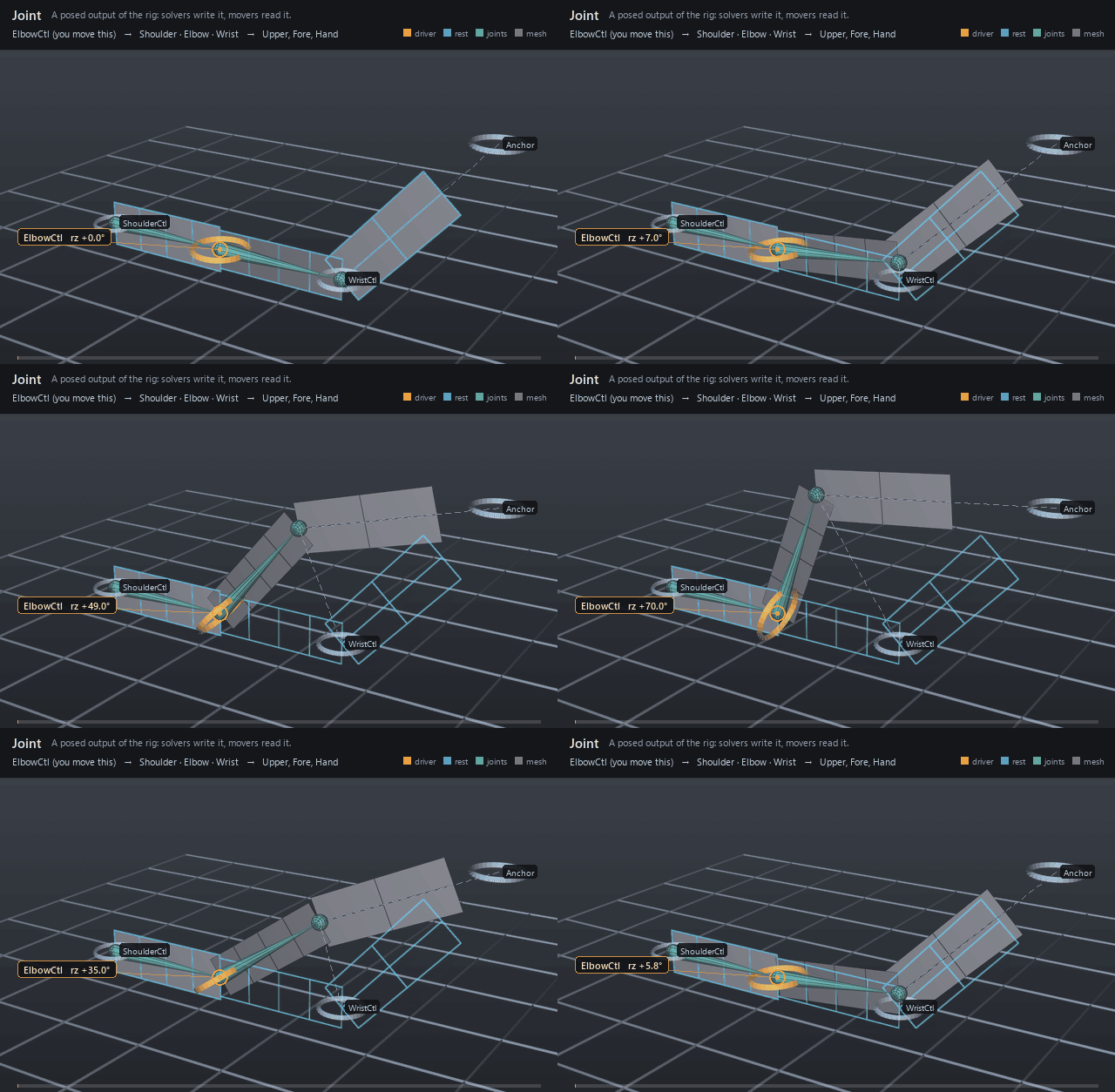
A three-joint arm whose wrist is written twice. The FK chain poses
shoulder, elbow, and wrist from three controls as the elbow control curls 70
degrees, then an aim constraint re-aims the wrist at a fixed anchor above and
beyond the hand in the pose phase. Each panel is skinned rigidly to its own
joint (Upper to Shoulder, Fore to Elbow, Hand to Wrist) and reads the final
phase, so the long hand panel keeps pointing at the anchor while the forearm
swings out from under it. In the GIF the pale spheres at the shoulder, elbow
and wrist are the joints themselves and the tapered wire between each pair is
the bone that the namespace nesting creates; the dashed line from the wrist to
Anchor is the pose-phase aim revision, not a control link. ShoulderCtl is
deliberately left unanimated, so the Upper panel sits on its own rest ghost
for the whole loop and the only motion in frame comes from the one driver.
Open it live with:
Re-render the GIF above with:
Tips
- Nest joints (Elbow inside Shoulder) so hierarchy, guides, and FK composition all agree — and remember
rest:spaceis measured from the parent joint's rest, not from the world. - Several solvers may pose one joint, and pose constraints are steps of the same kind in the same stack: the order is the composed namespace of the whole rig and nothing else, bottom sibling first. Put
Solversat the bottom of the rig to get the classic "solve, then revise" shape; a constraint that ends up BELOW a solver feeds it instead — every solver kind composes over the frame the steps below it left, so nothing is discarded either way. - A solver whose output another solver reads is naming joints for their rests, not claiming them, so an IK and an FK chain can both list the chain that their IK/FK blend actually poses.
- The bones of a 2D skeleton are plain nested joints too: their namespace is their hierarchy, and a bone runs to its first child joint, an
Endjoint for a leaf.