 Matrix Mover
Carries points by a provider's rigid delta under a weight field.
| Node type | RigExecMatrixMover |
| Example | matrix_mover.usda |
On this page:
Overview
The workhorse deformer: it reads one transform provider's
rest-relative delta and applies it to the moved points, scaled per point
by a weight object. One mover at constant weight is a rigid attachment;
several stacked on one target are applied in sequence, each from the
preceding revision, which is exact wherever a point has a single
influence and is not linear blend skinning where weights overlap — that
is the Skin Mover's job. Naming a bare prim — a joint, a control or an
Xformable — instead of a points property moves that prim's FRAME the
same way, as a step of the pose stack.
Moves the preceding value through one declared target-local affine transform, blended by the common MoverAPI envelope.
Two domains, chosen by what rigExec:moves names -- the same split the
write side draws everywhere:
GEOMETRY. One native point3f[] points property. Each point blends p' = q + w (T q - q).
TRANSFORM. One Xformable, RigExecControl or RigExecJoint. Its frame blends M' = T_w M, the exact twin of the point form and of UsdSkel's own pairing of ComputeSkinnedPoints with ComputeSkinnedTransform. The weight is one element, so inputs:defaultWeight is it unless a weight object with a single element is bound, and rigExec:weightBlend chooses the falloff exactly as it does for points.
A transform placed where a point is, given the same deformers in the same order at the same weights, lands where that point lands. That invariant is what makes a transform able to ride a deformer stack instead of approximating one with a blend of constraint sources.
How it works
The provider publishes computeMatrix, the rest-to-posed map of its
own frame (computations.cpp:416-432), and the mover blends it over the
incoming points as p' = q + w (T q - q) (schema.usda:2557-2558), where
w is the bound weight field or, with none bound,
inputs:defaultWeight. rigExecReadPhase metadata on
rigExec:transform chooses which revision of the provider is read: the default base binds the provider
itself, final binds the head of its frame chain
(matrixMover.cpp:105-118). The result is passed down the point chain,
and the compiler synthesizes the recompute revisions that keep authored
normals and extent on that gprim current. On a mesh, primvars:normals
wins over normals; vertex, varying and faceVarying normals keep their
layout, a leftHanded mesh's normals are negated, and indexed or other
interpolations refuse the compile.
Wiring
| Relationship | Points to | Required |
|---|---|---|
rigExec:transform |
Exactly one control or joint to follow. | yes |
rigExec:weightObject |
Weight field scaling the follow (optional; overrides the envelope when bound). | no |
rigExec:moves |
Exact points property to deform, or a bare joint, control or Xformable whose frame to move. | yes |
Parameters
Common mover envelope
rigExec:moves
Relationship.
Reserved write-set relationship: exact prim/property targets.
inputs:enabled
Type: bool. Default: true.
Shape-preserving enable. Disabled movers pass their preceding revision through unchanged (value-only edit).
inputs:defaultWeight
Type: float. Default: 1.
Normalized common mover envelope in [0, 1]. With no bound rigExec:weightObject it broadcasts over every logical element: zero passes the incoming value through bit-for-bit and one applies the mover's full-strength result. A non-finite value or one outside [0, 1] passes the incoming value through with a diagnostic.
rigExec:weightObject
Relationship.
Optional compatible total weight field, at most one target. When bound, the weight object's values (including its own sparse or constant fallback) supply the common envelope instead of inputs:defaultWeight. Target, domain, and cardinality must match each mover application; an incompatible binding is a compile error. A multi-target mover may bind only a constant operation envelope whose weightTarget is the mover prim itself; that one value broadcasts to every application of the atomic mover.
Node parameters
rigExec:pointFrame
Type: uniform token. Default: "rest".
Valid values: rest, posed.
WHICH FRAME the points this cluster moves are already in. Only meaningful with rigExec:transformSpace, and only in the geometry domain.
rest, the fallback, is a cluster that runs BEFORE the skin and so moves points still in the asset's own units. posed is one that runs after it and moves points a skin has already carried into the rig's posed frame.
The distinction is invisible until something above the rig is scaled, which is exactly why it needs saying. The offset rigExec:transformSpace measures is INVARIANT under a master scale -- both the transform and the space carry it on the right, so T * S^-1 gives the same answer either way -- and that is correct for a pre-skin cluster, whose own skin is still to come and will apply the scale itself. A post-skin cluster gets a mesh twice as big and an offset that has not grown, so it pulls the doubled mesh by the original distance.
posed conjugates the offset by the rig's CARRY, C^-1 M C, where C is rigExec:space's own rest->pose map. That is the whole correction and not a scale correction: for a master moved by T, (p + T) * T^-1 M T is p*M + T, which is what rigidity wants, and a rotated or scaled master needs nothing else said. One blanket answer cannot serve both families -- rest and posed need it in opposite directions -- which is why this says which, exactly as it does on RigExecCurveMover.
WITHOUT rigExec:space the conjugation falls back to the measuring space's own SCALE, which is all this could do before a carry could be named: it fixes a scaled master and does nothing at all for a translated or rotated one. A space nothing has scaled then measures (1,1,1) and the correction is skipped, so every rig without a scaled master and without a named carry is bit-identical.
rigExec:space
Relationship.
The prim whose movement away from its rest carries the whole rig -- normally a TRS master. Only meaningful with rigExec:pointFrame = "posed", and only in the geometry domain.
NOT the same thing as rigExec:transformSpace. That one is what the offset is MEASURED against -- the handle's own parent, so the points take the handle's motion inside it and not the space's. This one is what the POINTS the offset is applied to have already been carried by, which for a post-skin cluster is everything above the rig. The measured offset is invariant under the masters by construction (both terms carry them on the right and they cancel), so applying it to carried points shears them by T*R - T, growing with the master's motion and zero only when the offset has no rotation.
The carry used is the named prim's own rest->pose map -- what computeMatrix publishes -- so a master sitting at its rest contributes identity and a rig naming no space is unchanged, down to taking the same arithmetic branch it always did rather than multiplying by an identity.
rigExec:transform
Relationship.
Exactly one GfMatrix4d provider (computeMatrix).
rigExec:transformSpace
Relationship.
Optional second provider the transform is measured against: T = M(transform) * inverse(M(transformSpace)), both read at the same phase. With the transform nested under the space in the control hierarchy, T is the transform's own local motion carried to its rest pivot, so the points move by what the handle does inside the space and not by the space's motion -- a localized cluster, for geometry that is deformed at rest before it is skinned to that space.
rigExec:referenceTransform
Relationship.
Optional neutral-solve provider sharing transform's authored rest frame. Normalizes the transform as inverse(M(reference)) * M(transform), so the fitted neutral solve produces identity even when a solver has rest residuals or controls have default offsets. Read at rigExec:transform's read phase; the reference must have animation channels neutralized while sharing the live fitting parameters.
rigExec:referenceTransformSpace
Relationship.
Neutral counterpart of transformSpace. Required when both referenceTransform and transformSpace are supplied. Normalize both transforms independently before removing the space's motion.
rigExec:weightBlend
Type: uniform token. Default: "linear".
Valid values: linear, radial.
How a partial weight is taken.
linear is the default: p' = q + w(Tq - q), exact at both ends and a straight line between them.
radial takes a fraction of the transform's ROTATION instead, so a point keeps its distance from the axis at every weight. The two agree exactly at weight 0 and weight 1 and differ only in the falloff, where linear follows the chord of the arc. A chord always falls inside its arc, toward the axis, so a cluster that rotates a lid about an eyeball drives it INTO the eyeball at mid weight -- by r(1 - cos(theta/2)), which is a tenth of the radius at a 56 degree sweep.
Example
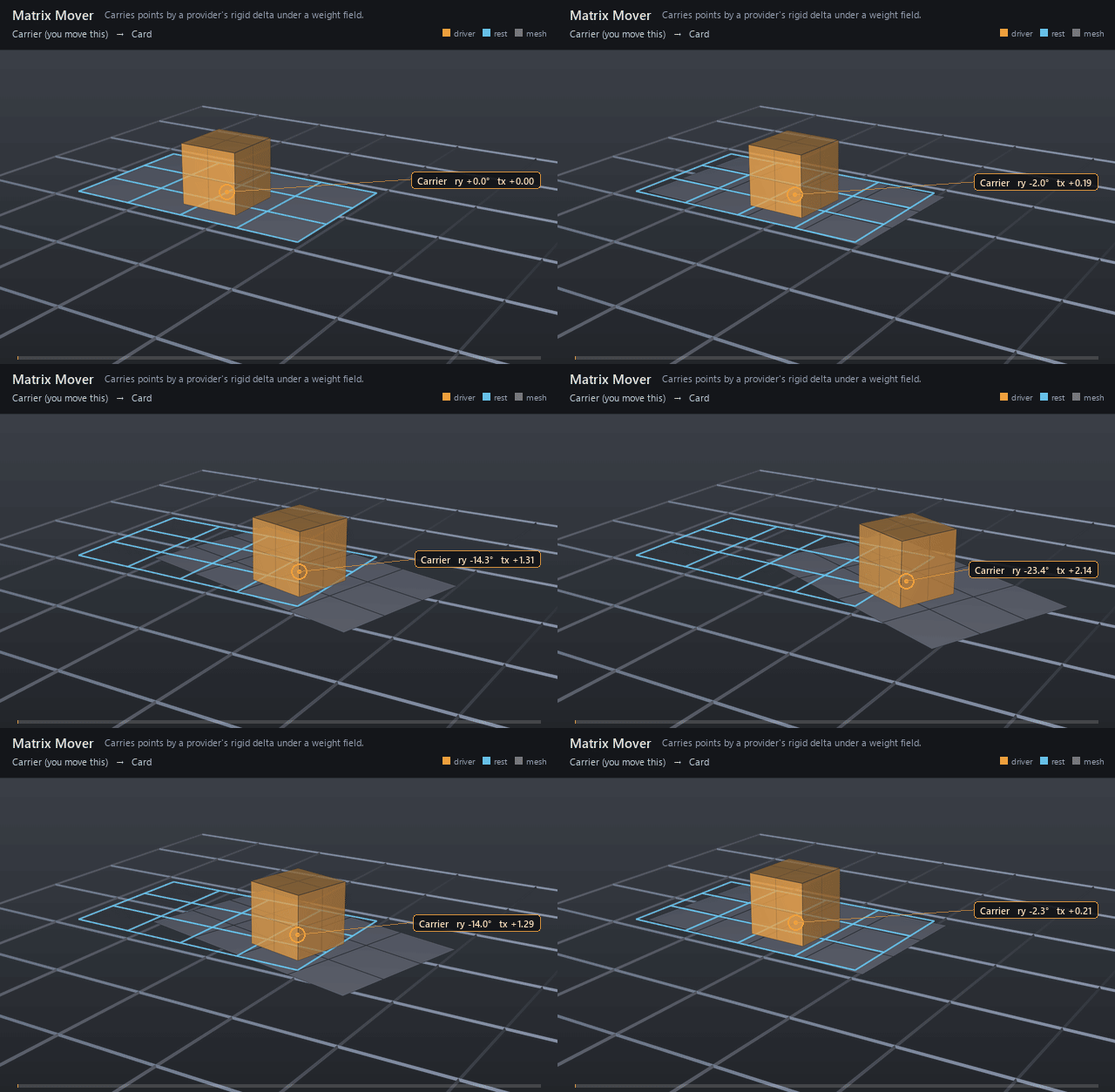
A solid box control sits on a flat card, and the mover's
rigExec:transform points straight at that control — no joint in between —
so the card is rigidly bolted to the handle. The box slides 2.2 units along
X and yaws 24 degrees and back, and the card goes with it corner for corner,
which is what "rigid delta" means. No weight object is bound and the envelope
stays at 1, so the follow is full strength over every point of the card.
Open it live with:
Re-render the GIF above with:
Tips
- The provider may be a control as readily as a joint: those are the only two types
rigExec:transformaccepts (matrixMover.cpp:273-279). finalbinds the provider's frame-chain head, so every pose step above it is included; the defaultbaseis the joint after the LAST SOLVER wrote it, which is not the same as "before every constraint" — a constraint that sits below the last solver is folded intobasethrough that solver. Name a prim if you want a specific moment: theSolversscope means "after the last solver", theMoversscope "after the last constraint" (matrixMover.cpp:105-118).- Same-target movers are an ordinary stack ordered by the composed namespace: reverse-sibling post-order, so descendants run before their parent and the bottom sibling before the top (spec section 4.2). Stacking is how you layer rigid follows, not how you blend influences on one point — use the Skin Mover for that (schema.usda:2690-2695).
rigExec:weightBlend = "radial"blends a fraction of the rotation instead of the chord, so a partly weighted point keeps its distance from the driver's pivot; the defaultlinearis the classic cluster. A frame mover blends its landmark points the same way (examples/15_TransformMatrixMover.usda).