 Lattice Mover
Deforms points through a legacy cage or a regular interpolation grid.
| Node type | RigExecLatticeMover |
| Example | lattice_mover.usda |
On this page:
Overview
Free-form deformation: a native Points or mesh cage surrounds the geometry, and posing the cage (default time is the bind, timeSamples are the posed cage) carries the moved points through tensor-product basis evaluation. Fewer cage points than mesh vertices drive broad, smooth shaping — bulges, bends, squash and stretch.
Reads cage points from a native mesh/points prim and writes exactly one exact native UsdGeomPointBased points property through tensor-product basis evaluation. rigExec:cage honors rigExecReadPhase metadata. rigExec:evaluation selects the basis; rigExec:basis is not read.
How it works
The default rigExec:evaluation = legacy is the tensor-product
Bernstein cage evaluator. regularGrid interpolates cage displacement from
canonical origin and spacing, with separate linear, cardinal, B-spline or
Catmull-Rom interpolation on each axis. divisions uses x-fastest ordering;
single-point axes are supported. Outside coordinates retain their extrapolated
basis weights while individual cage indices clamp at the boundary.
strength and per-point mask scale the displacement before the common mover
envelope. cageMatrix and targetMatrix, optionally followed by the two
frames providers, define the coordinate spaces. pointSpace = common is for
points already in a shared asset space; local is for object-local points.
These settings and frames belong to regularGrid; authoring them with
legacy fails the mover's compile check. The cage points are read at the
rigExecReadPhase declared on rigExec:cage; frames providers take
base or final.
.rigexec exports carry these settings from format revision 21. A revision
20 file has none of them and plays the legacy cage evaluator.
Wiring
| Relationship | Points to | Required |
|---|---|---|
rigExec:cage |
Native Points/mesh prim supplying cage points. | yes |
rigExec:moves |
Exact points property to deform. | yes |
Parameters
Common mover envelope
rigExec:moves
Relationship.
Reserved write-set relationship: exact prim/property targets.
inputs:enabled
Type: bool. Default: true.
Shape-preserving enable. Disabled movers pass their preceding revision through unchanged (value-only edit).
inputs:defaultWeight
Type: float. Default: 1.
Normalized common mover envelope in [0, 1]. With no bound rigExec:weightObject it broadcasts over every logical element: zero passes the incoming value through bit-for-bit and one applies the mover's full-strength result. A non-finite value or one outside [0, 1] passes the incoming value through with a diagnostic.
rigExec:weightObject
Relationship.
Optional compatible total weight field, at most one target. When bound, the weight object's values (including its own sparse or constant fallback) supply the common envelope instead of inputs:defaultWeight. Target, domain, and cardinality must match each mover application; an incompatible binding is a compile error. A multi-target mover may bind only a constant operation envelope whose weightTarget is the mover prim itself; that one value broadcasts to every application of the atomic mover.
Node parameters
rigExec:cage
Relationship.
Native mesh/points prim supplying cage control points.
rigExec:basis
Type: uniform token. Default: "bspline".
Valid values: bspline, bernstein.
rigExec:divisions
Type: int3. Default: (2, 2, 2).
rigExec:evaluation
Type: uniform token. Default: "legacy".
Valid values: legacy, regularGrid.
Legacy binds each base point into the bound of the cage's default-time points and moves the incoming point by the Bernstein blend of the cage's motion from them; it needs at least two divisions per axis, and an authored regular-grid setting (interpolation, origin, spacing, strength, mask, pointSpace, cageMatrix, targetMatrix or frames) is a compile error. Regular grid interpolates current cage displacement against canonical origin/spacing at each incoming point and needs at least one division per axis.
rigExec:interpolationU
Type: uniform token. Default: "bspline".
Valid values: bspline, linear, cardinal, catmullRom.
rigExec:interpolationV
Type: uniform token. Default: "bspline".
Valid values: bspline, linear, cardinal, catmullRom.
rigExec:interpolationW
Type: uniform token. Default: "bspline".
Valid values: bspline, linear, cardinal, catmullRom.
rigExec:origin
Type: float3. Default: (-0.5, -0.5, -0.5).
rigExec:spacing
Type: float3. Default: (1, 1, 1).
rigExec:strength
Type: float. Default: 1.
rigExec:mask
Type: float[]. Default: [].
rigExec:pointSpace
Type: uniform token. Default: "local".
Valid values: local, common.
rigExec:cageMatrix
Type: matrix4d. Default: ((1,0,0,0),(0,1,0,0),(0,0,1,0),(0,0,0,1)).
rigExec:targetMatrix
Type: matrix4d. Default: ((1,0,0,0),(0,1,0,0),(0,0,1,0),(0,0,0,1)).
rigExec:frames
Relationship.
Optional cage and target rest-to-pose providers: none, or exactly these two in that order, applied after their local-to-common matrices. Regular grid only; a checkpoint read phase is a compile error.
Example
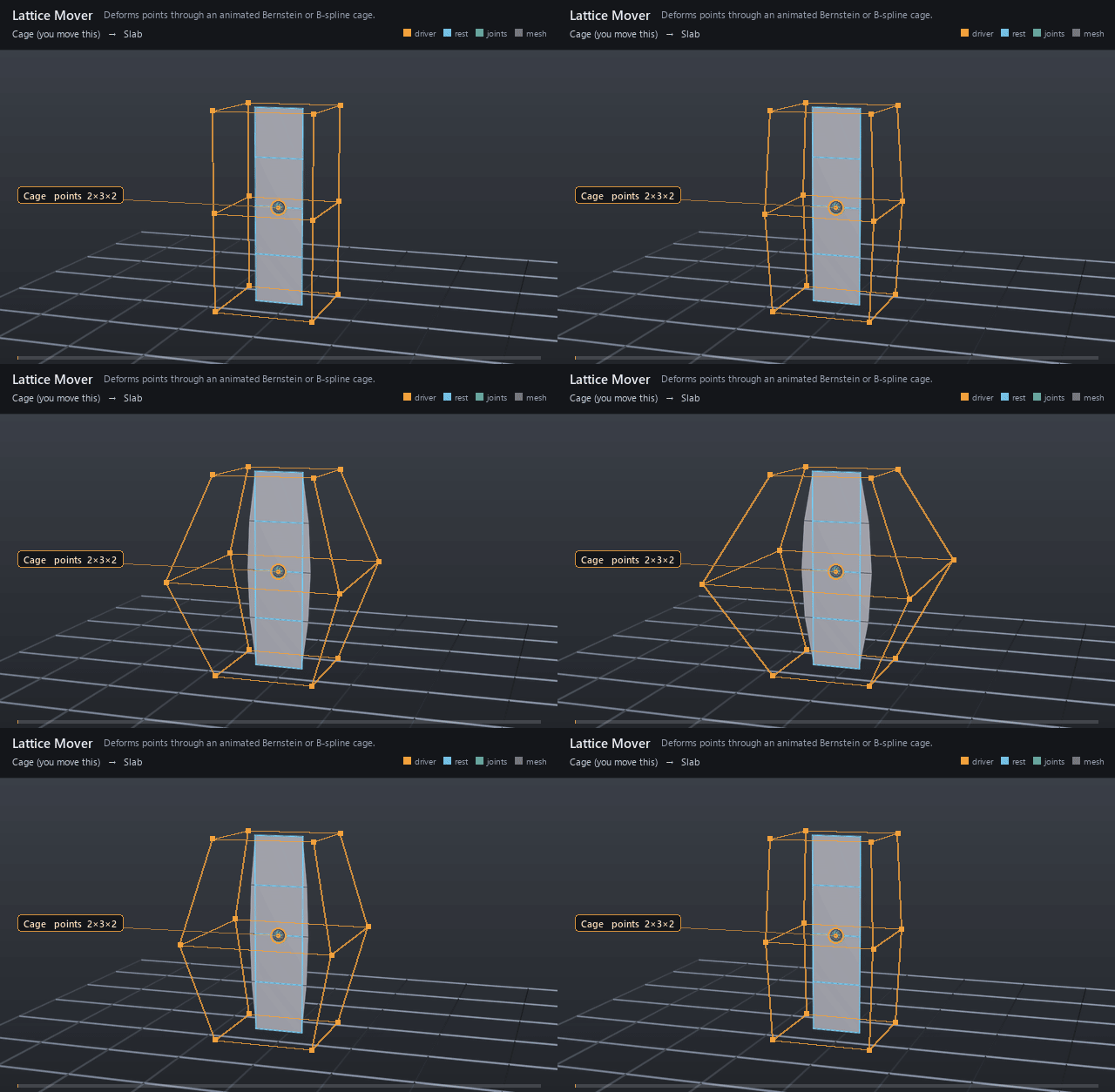
A 2×3×2 Bernstein cage bulges its middle layer outward and back, widening the middle of a vertical strip. Bind and posed cage share the same point ordering.
Open it live with:
Re-render the GIF above with:
Tips
- Hide the cage (
visibility = invisible): it is scaffolding, not geometry. - Follow a bulge with a Smooth mover to settle the lattice falloff or a Volume Correct mover to hold girth.