 Two-Bone IK
Aims a two-segment limb at an effector with pole-vector control.
| Node type | RigExecTwoBoneIk |
| Example | two_bone_ik.usda |
On this page:
Overview
Analytic two-bone inverse kinematics for arms and legs. The root stays planted on its control, the end joint reaches for the effector control, and the pole control picks which way the middle joint bends. Bone lengths are measured from the bound joints' rests on every evaluation — there is nothing absolute to author or keep in sync.
Analytic two-bone IK with pole, stretch, softness, and preferred bend. Publishes computePointFrameArray of [root, mid, end] frames.
How it works
Each evaluation measures root-to-mid and mid-to-end from the
frames the joints carry on entry to this solver — their rest:space rests
unless a step below it in the pose stack already wrote them — plus the length
offsets, then solves the two-bone chain in the plane through the pole. inputs:stretch lets the chain elongate toward
out-of-reach goals under rigExec:stretchPolicy, and
rigExec:unreachablePolicy with inputs:softness shapes the lock-up as
the goal leaves reach.
Wiring
| Relationship | Points to | Required |
|---|---|---|
rigExec:effectorControl |
Control supplying the end-goal position. | yes |
rigExec:poleControl |
Control defining the bend plane. | yes |
rigExec:rootControl |
Control planting the chain root. | yes |
rigExec:joints |
Three nested joints: root, mid, end — the chain this solver measures and writes. It is an ordered write, not an exclusive claim: another step may write the same joints, and the last writer in the stack supplies their base frame. The solver measures the two bones from the frames the joints carry ON ENTRY, so a step BELOW it that moves one of them re-proportions the limb rather than only re-orienting it. | yes |
Parameters
Node parameters
purpose
Type: uniform token. Default: "guide".
Render purpose, overriding UsdGeomImageable's default
fallback: joint and solver guides are DIAGNOSTICS, drawn when a
viewer asks for guides.
This is the stock attribute rather than a RigExec-specific token so
that the bounds and the drawing cannot disagree: UsdGeomBBoxCache
classifies a prim's extent by this exact attribute, and the results
scene index stamps the same resolved value onto the guide it
synthesizes. A control keeps the inherited default -- it is the
rig's interaction surface, not a diagnostic -- and authoring
guide on one moves both its drawing and its bounds together.
rigExec:rootControl
Relationship.
rigExec:effectorControl
Relationship.
rigExec:poleControl
Relationship.
rigExec:upperLengthOffset
Type: double. Default: 0.
Delta added to the measured upper length. The upper bone is measured from the bound joints' rest positions (root to mid) and this offset adjusts it -- zero leaves the measured bone length exact. There is no absolute length attribute: the bone is the measured rest distance in the space of rigExec:space and rigExec:spaceMatrix, the offset scales with that space, and softDistance multiplies the result by inputs:upperScale.
rigExec:lowerLengthOffset
Type: double. Default: 0.
Delta added to the measured lower length. The lower bone is measured from the bound joints' rest positions (mid to end) and this offset adjusts it -- zero leaves the measured bone length exact. There is no absolute length attribute: the bone is the measured rest distance in the space of rigExec:space and rigExec:spaceMatrix, the offset scales with that space, and softDistance multiplies the result by inputs:lowerScale.
rigExec:stretchPolicy
Type: uniform token. Default: "uniformSegments".
Valid values: uniformSegments, softDistance.
uniformSegments: inputs:stretch is the stretch permitted beyond full reach and inputs:softness a fraction of the chain.
softDistance: the limb model. Each bone starts at its rest length times inputs:upperScale / inputs:lowerScale; past full reach less inputs:softDistance both bones grow so the reach eases in rather than snapping straight; inputs:stretch blends that growth in; and inputs:pin blends both bones toward the lengths that put the middle joint on the pole (root to pole, pole to goal).
inputs:pin
Type: float. Default: 0.
softDistance: how far the middle joint is pinned to the pole, in [0, 1]. One makes the bones exactly root-to-pole and pole-to-goal long, so the elbow or knee sits on the pole control.
inputs:upperScale
Type: double. Default: 1.
softDistance: multiplier on the upper bone's rest length.
inputs:lowerScale
Type: double. Default: 1.
softDistance: multiplier on the lower bone's rest length.
rigExec:scaleCalibration
Type: uniform double. Default: 0.
softDistance: subtracted from inputs:upperScale and inputs:lowerScale inside the soft stretch only, so a chain that sits inside the soft zone at its bind pose still solves to its rest lengths there. The unstretched lengths use the scales as given.
inputs:softDistance
Type: float. Default: 0.
softDistance: how far short of full reach the soft ease begins, in the chain's units. Zero stretches the moment the goal is past reach.
inputs:twist
Type: float. Default: 0.
Degrees the bend plane turns about the root-to-goal axis after the pole has set it.
rigExec:segmentScale
Type: uniform token. Default: "none".
Valid values: none, toChild.
toChild: the root and middle frames scale along their bones by solved length over rest length, so a stretched bone stretches its joint (and the skin bound to it), not only moves the next one.
rigExec:unreachablePolicy
Type: uniform token. Default: "clampWithSoftness".
Valid values: clampWithSoftness.
rigExec:preferredBendRadians
Type: double. Default: 0.
inputs:stretch
Type: float. Default: 1.
Permitted stretch beyond full reach, in [0, 1].
inputs:softness
Type: float. Default: 0.
Soft-reach fraction of the chain length.
rigExec:joints
Relationship.
Ordered output joints [root, mid, end] posed by this solve. Position is the element index; the compiler binds each joint to one aggregate element.
rigExec:space
Relationship.
The prim whose movement away from its rest defines the space this chain is measured in -- normally a TRS master.
A RELATIONSHIP, not a connection to posed:space: a control's
posed space is computed, not authored, so an attribute connection
to it resolves to the unauthored identity and the solver silently
keeps its old lengths. Naming the prim instead pulls the same
computed frame the root, effector and pole already come through.
The space used is rest-inverse-times-posed, so a master sitting at its rest contributes identity and a rig that names nothing is unchanged.
rigExec:spaceMatrix
Type: matrix4d. Default: ( (1, 0, 0, 0), (0, 1, 0, 0), (0, 0, 1, 0), (0, 0, 0, 1) ).
The space the chain's REST measurements are carried into before they are compared with the posed goal.
Bone lengths are measured from the bound joints' rests, and the root, goal and pole arrive as posed frames. The two agree only while whatever sits above the rig is unscaled: put the rig under a scaled master and the goal moves twice as far away while the chain keeps its authored length, so the solve clamps and the limb straightens instead of scaling.
Name whatever the rig hangs from -- a TRS master, a shot transform -- on rigExec:space rather than connecting this to its posed:space: that space is computed, so the connection reads the unauthored identity. This matrix is an explicit extra factor, composed after rigExec:space's rest-to-posed map; the length offsets and inputs:softDistance ride the same space. Identity, the fallback, measures the rests as authored, so a rig that authors nothing is unchanged.
guide:radius
Type: double. Default: 1.0.
Radius of the sphere and cone drawn at each aggregate element: the exact counterpart of RigExecJoint's guide:radius, including the rule that zero or negative draws no guides at all, which is how a solver's diagnostics are turned off.
Without it the elements draw at Hydra's fallback radius of 1.0, which is proportionate on an asset authored at tens of units and several times the size of the whole character on one authored at one unit.
guide:displayColor
Type: color3f. Default: (0.3, 0.6, 1.0).
guide:displayOpacity
Type: float. Default: 0.5.
Example
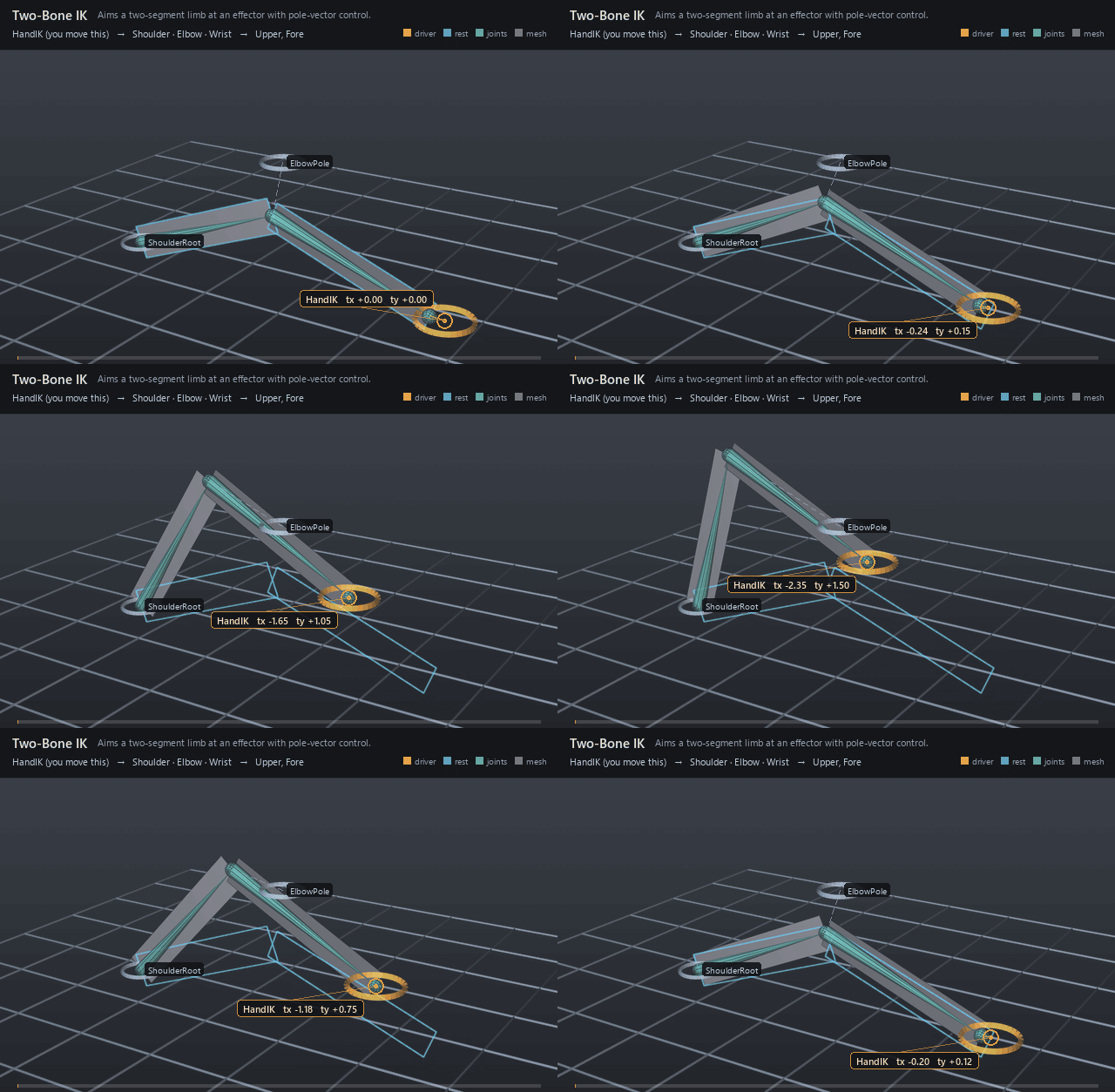
A two-card arm bends as its hand effector swings in and lifts. The effector rests just inside full reach so the arm holds a slight natural bend; the pole above the elbow keeps the bend plane facing the camera.
Open it live with:
Re-render the GIF above with:
Tips
- Keep the pole on the side you want the joint to favor; the solver builds a right-handed bend basis, so pole-above bends keep +Z-facing cards front-facing.
- Rest the effector just inside full reach: exactly straight is a singularity where the bend plane is undefined.
- Move a joint rest and the limb re-proportions itself — IK never caches bone lengths.