 Space Switch
Gives a control a labelled list of parent spaces, selected or blended by an index.
| Node type | RigExecSpaceSwitch |
| Example | space_switch.usda |
On this page:
Overview
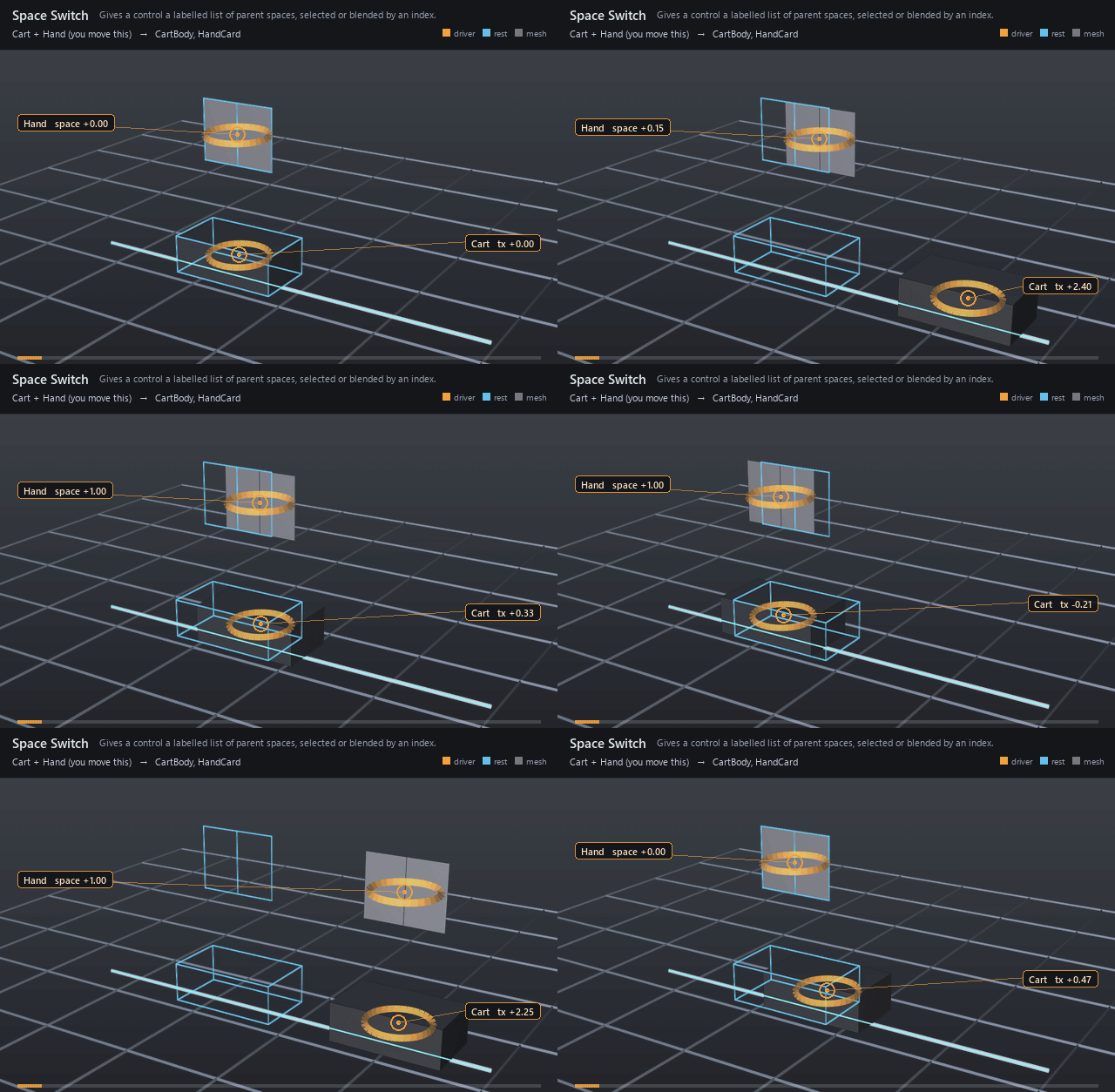
A space switch replaces one control's PARENT SPACE with one of an ordered list of sources — world, the chest, the head — chosen by a live index. It does not write the control's pose: the control keeps composing from its own avars, so it still drags, still carries its namespace children, and its avars read as offsets in whichever space is selected. A whole-number index selects a space exactly; a fractional one blends the two it lies between, so a switch can be eased instead of stepped.
A labelled list of parent spaces for one xformable, with a live index selecting between them.
It is NOT a pose constraint: it does not write the target's pose. It replaces the target's PARENT SPACE, which is the whole point -- the control keeps composing from its own avars, so it still drags, still carries its namespace children, and its avars still read as local offsets in whatever space is selected.
The composition, in row-vector convention, is
world = avars * default:space * inverse(source default:space) * source posed:space
which is the ordinary xformable ladder with the namespace parent's pair of spaces swapped for the selected source's pair. Both halves come from the same source, so at rest the two cancel and EVERY space gives the same answer: adding or changing a space switch cannot move a rig at rest, and cannot move it at all while the selected source is unposed. Switching mid-pose DOES move the control; matching the pose across a switch is a tool's job, not the engine's.
A source that is not an xformable provider -- the RigExecRoot itself is the idiomatic one -- contributes identity, which is how "world" is spelled without inventing a prim to stand for it.
The inherited per-axis masks apply to the delta the space contributes, expressed in the TARGET's own default frame, so masking translation off leaves an orient-only space that rotates the control about its own pivot, and masking rotation off leaves a point-only one. The inherited inputs:sourceWeights plays no part here -- inputs:activeSpace is the selector -- and authoring it is a compile error rather than a silent no-op.
How it works
The switch is read at compile time and changes how its target
composes. In row-vector convention the target's world matrix is
avars * default:space * inverse(source default:space) * source posed:space:
the ordinary transform ladder with the namespace parent's pair of spaces
swapped for the selected source's pair. Both halves come from the same
source, so at rest they cancel and every space gives the same answer —
adding a switch never moves a rig at rest. A source that is not a frame
provider (the RigExecRoot itself is the idiomatic one) contributes
identity, which is how "world" is spelled. The inherited per-axis masks
act on the delta the space contributes, expressed in the target's own
default frame, and rigExec:rotationFilters can pass only the twist of a
source's rotation about rigExec:twistAxis, or only the swing, by an
exact swing-twist decomposition, or take only its rotation (orient).
The index is an ordinary per-frame input:
the native program, frozen jobs, the frame cache and a .rigexec
binary all re-read it every frame, and keying it re-runs only the compose
of the switched control's subtree.
Wiring
| Relationship | Points to | Required |
|---|---|---|
rigExec:target |
The one control (or other transform provider) whose parent space is switched. Zero or several is a compile error. | yes |
rigExec:sources |
The spaces, in index order. The rig root (or any prim that is not a frame provider) means world. | yes |
rigExec:activeSpaceAttribute |
A float or double property supplying the index, normally an avar on the control itself; when authored it wins over inputs:activeSpace. |
no |
rigExec:space |
The master whose rest-to-posed motion carries the whole rig, so a rotation filter does not discard it. | no |
Parameters
Constraint base
rigExec:locked
Type: uniform bool. Default: false.
Authoring lock metadata for application interchange. Evaluation remains active while locked; use RigExecMoverAPI inputs:enabled or inputs:defaultWeight to disable or blend the operation.
inputs:affectTranslationX
Type: bool. Default: true.
Per-axis translation mask. Ignored groups are a compile error.
inputs:affectTranslationY
Type: bool. Default: true.
inputs:affectTranslationZ
Type: bool. Default: true.
inputs:affectRotationX
Type: bool. Default: true.
Per-axis rotation mask. Ignored groups are a compile error.
inputs:affectRotationY
Type: bool. Default: true.
inputs:affectRotationZ
Type: bool. Default: true.
inputs:affectScaleX
Type: bool. Default: true.
Per-axis scale mask. Ignored groups are a compile error. RigExecParentConstraint overrides the default to false to match the FBX runtime, which leaves scale off unless it is asked for.
inputs:affectScaleY
Type: bool. Default: true.
inputs:affectScaleZ
Type: bool. Default: true.
inputs:translationOffset
Type: double3. Default: (0, 0, 0).
Additive translation offset applied after the source blend.
inputs:rotationOffset
Type: double3. Default: (0, 0, 0).
Additive Euler rotation offset in degrees, applied after the blend.
inputs:scaleOffset
Type: double3. Default: (0, 0, 0).
ADDITIVE scale offset applied after the blend, which is why its identity is (0, 0, 0) and not (1, 1, 1): the kernel computes blendedScale + offset. A multiplicative offset would be a different operator, not a different default.
rigExec:rotationOrder
Type: uniform token. Default: "XYZ".
Valid values: XYZ, XZY, YXZ, YZX, ZXY, ZYX.
Euler order for the operators that compose a rotation. Authoring it on one that does not is a compile error.
Ordered sources
rigExec:sources
Relationship.
Ordered transform sources. Order is preserved through composition because it identifies entries in every parallel source array.
inputs:sourceWeights
Type: float[]. Default: [].
Per-source weights parallel to rigExec:sources. An empty array gives every source equal, full weight. A non-empty array must have exactly one entry per source. Weights are relative: the sources mix by weight over their total, and each must be finite and not negative.
Node parameters
rigExec:target
Relationship.
The one RigExecXformable whose parent space is switched. Exactly one target; zero or several is a compile error, and so is a target named by more than one space switch.
rigExec:space
Relationship.
The prim whose movement away from its rest carries the whole rig -- normally a TRS master.
A switch composes its target over the target's DEFAULT ancestors,
so a master's motion reaches a switched control only INSIDE the
source's motion. With rigExec:rotationFilters left at all that
is harmless: the mask is the identity and the carry passes
through. Ask for twist or swing and the filter throws the
master's rotation away along with the part it was told to drop.
Naming the space runs the filter on the master-free motion and re-applies the carry afterwards, so only the source's own rotation is ever filtered. The space used is rest-inverse-times-posed, so a master sitting at its rest contributes identity and a rig that names nothing is unchanged.
A RELATIONSHIP, not a connection to posed:space, for the same
reason as RigExecTwoBoneIk: a control's posed space is computed,
never authored, so an attribute connection to it resolves to the
unauthored identity and the filter silently keeps eating the
carry.
rigExec:spaceLabels
Type: uniform token[]. Default: [].
UI labels parallel to rigExec:sources. Empty falls back to the source prims' names. A non-empty array must have exactly one entry per source. A token-valued rigExec:activeSpaceAttribute selects a space by these labels.
inputs:activeSpace
Type: double. Default: 0.
Index into rigExec:sources, clamped to the list. A whole number selects that space exactly; a fractional value blends the two it lies between, so a switch can be eased rather than stepped. Ignored when rigExec:activeSpaceAttribute names a property.
rigExec:activeSpaceAttribute
Relationship.
Optional single float, double or token PROPERTY supplying the
index, so the animator-facing channel can live on the control itself
-- space:active beside its avars -- rather than on this prim. A
token selects the source whose label (rigExec:spaceLabels, or the
source prim's name) it holds; a token that matches none selects
index 0. When authored it is authoritative and inputs:activeSpace is
ignored.
rigExec:rotationFilters
Type: uniform token[]. Default: [].
Valid values: all, twist, swing, orient.
Optional per-source rotation filter, parallel to rigExec:sources. Empty, or "all", passes the source's rotation through whole.
"twist" passes only the source's rotation ABOUT rigExec:twistAxis and drops everything else; "swing" passes only the remainder. The split is the exact swing-twist decomposition of the source's rotation delta, not an Euler mask, so it stays well behaved at large angles where per-axis masking does not.
This is what a pole vector living in its hand's or foot's space wants: the elbow should follow the forearm's TWIST and must not swing around with the wrist, because a pole that swings with the thing it aims is a pole that fights the animator.
Translation and scale are unaffected: the pole still follows the hand's position.
"orient" makes the source a rotation-only space: the target takes the source's whole rotation, and its position stays where its namespace parent carries it, as if the space were not switched. A shoulder, neck or head held to the world turns with the world and still rides on the body.
rigExec:twistAxis
Type: double3. Default: (1, 0, 0).
Twist axis for rigExec:rotationFilters, in the SOURCE's own rest axes -- the limb axis for a wrist or an ankle. One axis serves every filtered source; a switch needing two would be two switches.
Example
A cart slides along a track and a hand control floats above
it. The hand is the cart's sibling, not its child, so in namespace it lives
in world space; the HandSpaces switch lists world (the rig root) and the
cart, and reads its index from the hand's own avars:space. For the first
eleven frames the index is 0 and the cart drives away beneath a hand that
stays put. Over the next twelve the index eases from 0 to 1 and the hand
glides across onto the cart — halfway at the midpoint, because a fractional
index blends the two spaces. From then on the hand rides the cart out and
home again, and with the cart back at rest both spaces agree, so the loop
closes where it began.
Open it live with:
Re-render the GIF above with:
Tips
- Switching mid-pose moves the control: the same avars now mean an offset in a different space. Matching the pose across a switch is a tool's job (key the avars at the switch frame), not the evaluator's.
- Put the index on the control the animator already selects, through
rigExec:activeSpaceAttribute— anavars:spacechannel keys, shows in the avar editor and undoes like any other avar. inputs:sourceWeightshas no meaning here — the index is the selector — and authoring it is a compile error rather than a silent no-op.- A pole vector that should follow a hand's twist but not its swing takes
rigExec:rotationFilters = ["all", "twist"]withrigExec:twistAxisalong the forearm. - A source or
rigExec:spaceunder the switch's own target, with no other switched control in between, moves with the answer it feeds: that is a cycle and refuses to compile, as do two switches that each need the other composed first. A source under another switched control is fine, even one nested inside this switch's target: the nested switch resolves first. - A switch whose target is a bone of a Skeleton 2D is read by that skeleton inside its solve, not run as a step of its own; its sources may then be bones of the skeleton, and the rig root stands for the skeleton's start frame.