 Combine Weight
Folds several weight fields into one under a single mode.
| Node type | RigExecCombineWeight |
| Example | combine_weight.usda |
On this page:
Overview
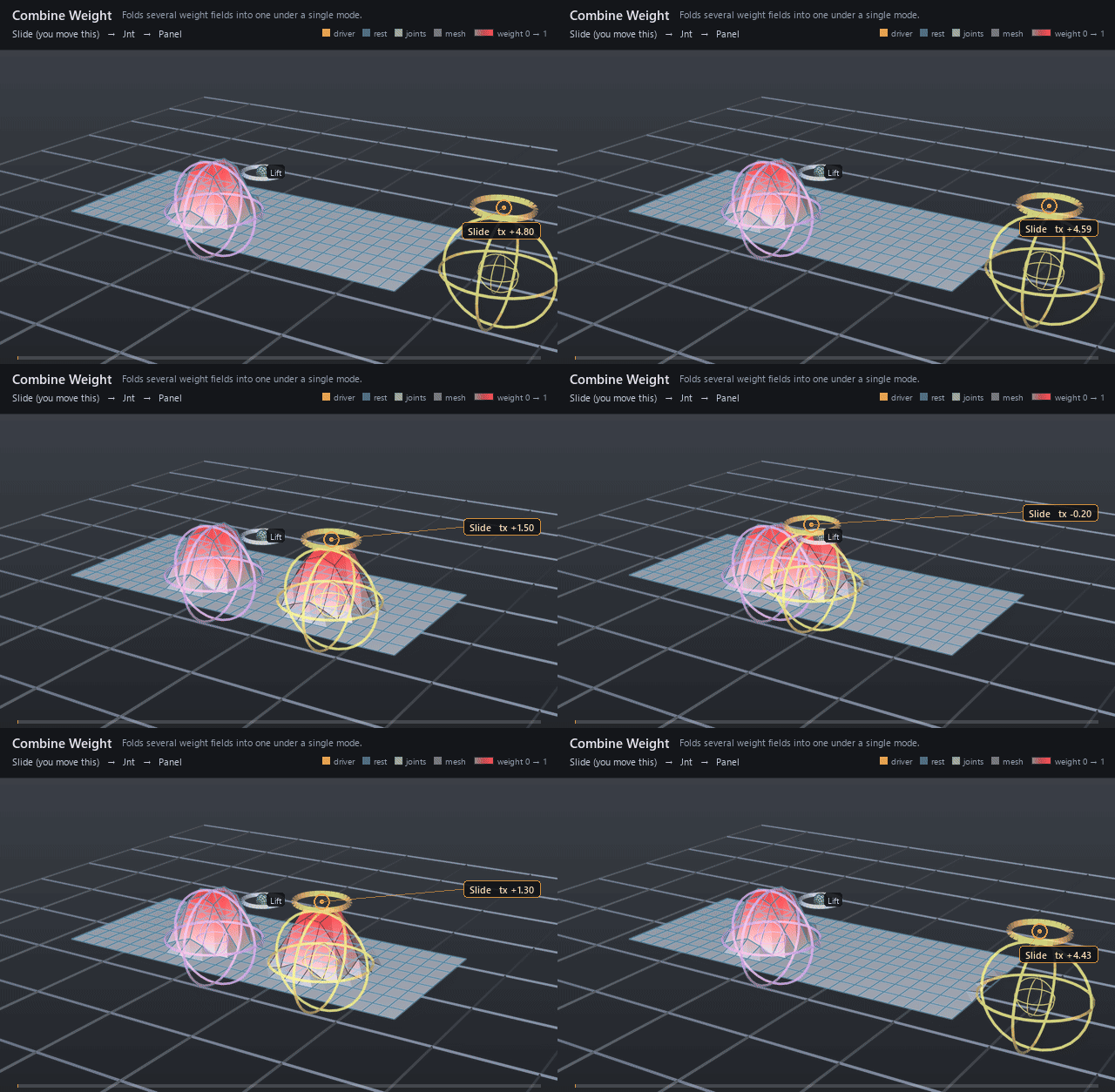
The operator that makes weight objects composable: a painted static
field masked by a sphere volume, two volumes unioned with max, a driven
dynamic weight subtracted out. Every input is resolved to a dense field
over the same elements and folded with one rigExec:combineMode, so the
result is an ordinary weight object that any mover can bind. One combine
carries one mode; mixed compositions nest combines inside combines rather
than tagging individual targets.
Folds an ordered list of weight objects into one field.
This is what makes weight objects composable: a painted
RigExecStaticWeight masked by a RigExecSphereWeight, two spheres
unioned with max, a driven RigExecDynamicWeight subtracted out.
Combines nest, and nesting is how mixed modes are expressed -- one combine carries one mode, so a relationship never has to carry per-target metadata.
How it works
The fold runs when the bound mover evaluates, in the geometry
(point-chain) phase, after the pose phase has placed every volumetric input — a volume weight is a
RigExecXformable, so the pose walk gives it a provider slot exactly
like a joint's. It resolves each rigExec:inputWeights target to a dense
field of the mover's element count (its own rigExec:weightTarget is
read only for that count, never for its points), folds them under the
mode — multiply, add, subtract, max, min, average, or
overlay — then applies inputs:invert and inputs:strength as
w = (w + (1 - 2w) * invert) * strength and bounds the result under
rigExec:rangePolicy. One invalid or differently sized input fails the
whole packet rather than folding a truncated field, and the mover passes
its points through unchanged.
Wiring
| Relationship | Points to | Required |
|---|---|---|
rigExec:inputWeights |
Ordered weight objects to fold; every one must cover the same target as this combine. | no |
rigExec:weightTarget |
The weighted domain, matching the bound mover's exact target; read only for its element count. | yes |
| (bound by) | A mover's rigExec:weightObject applies the folded field. |
- |
Parameters
Weight field
guide:weightDisplay
Type: uniform token. Default: "tint".
Valid values: tint, heatmap, bands.
Selected influence overlay: tint blends gray to red; heatmap interpolates dark blue, blue, teal, yellow and red at weights 0, .25, .5, .75 and 1. bands assigns five colors in .2-wide bins. Colors use resolved vertex weights, clamped to [0,1] for display; faces interpolate them, so bands are approximate on coarse meshes. Does not change weights, materials or opacity on the source stage.
rigExec:weightTarget
Relationship.
Canonical prim or exact property carrying the weighted domain. For a constant envelope over an atomic multi-target mover, this is the mover prim itself.
rigExec:representation
Type: uniform token. Default: "constant".
Valid values: constant, dense, sparse.
rigExec:rangePolicy
Type: uniform token. Default: "strict".
Valid values: strict, clamp.
Node parameters
rigExec:representation
Type: uniform token. Default: "dense".
Valid values: dense.
Redeclared to override the RigExecWeightObject fallback
of constant, which a combine cannot honour: it resolves every
input to a dense field before folding, so dense is the only
representation it can publish.
With the base fallback, a DEFAULT combine -- author the prim, wire two inputs, change nothing else -- would publish an invalid packet, and a schema fallback its own kernel rejects is simply the wrong fallback.
rigExec:inputWeights
Relationship.
Ordered weight objects to fold. Every input must resolve to the same element count as this combine's own weightTarget; a mismatch fails the packet rather than folding a truncated field, because a short input would silently read as identity over its missing tail.
rigExec:combineMode
Type: uniform token. Default: "multiply".
Valid values: multiply, add, subtract, max, min, average, overlay.
multiply, add, max, min, and average are order independent. subtract and overlay are NOT: they seed from the first input and fold the rest in authored target order, which is where weight composition departs from the rule that target-list permutation cannot change a result. Authors who need a permutation-proof composition use a commutative mode.
inputs:strength
Type: float. Default: 1.
inputs:invert
Type: float. Default: 0.
Reflects the folded field about 0.5; lerped, as elsewhere.
Example
Two sphere volumes over one flat 192-quad panel, folded with max.
A static joint holds a 1.0-unit lift, so the panel's height is literally
the combined field. The Anchor volume sits still at x = -1.2; the Slider
volume rides an animated control from x = 4.8 — parked clear of the panel,
where it contributes nothing, so the first frame is an honest picture of
the Anchor field alone — in to x = -0.2, holds there, and leaves again.
A second dome arrives, the two stand apart with a flat valley between
them, then merge into one wide ridge. max is the union, so neither
volume can ever dim the other; swap it for min and only the lens where
both volumes agree is left standing, and multiply softens that same
intersection.
Open it live with:
Re-render the GIF above with:
Tips
multiply,add,max,min, andaverageare order independent;subtractandoverlayseed from the first target and consume the authored order, so reordering the relationship changes the result for those two alone.- A combine must publish
dense— it is the schema fallback and the only value its kernel accepts — but its inputs may be constant, sparse, dense, or generated; each is resolved to dense before the fold. rigExec:rangePolicyis inherited unchanged fromRigExecWeightObject, so a combine falls back tostrict-- unlike the volume weights, which redeclare it asclamp. Authorclamp, as the example does, or anaddthat overlaps past 1 (or an overdriveninputs:strength) invalidates the packet and the mover passes its points through with aMoverFaileddiagnostic.