 Single-Chain IK Constraint
Re-poses an existing joint chain of any length onto an effector goal.
| Node type | RigExecSingleChainIkConstraint |
| Example | single_chain_ik_constraint.usda |
On this page:
Overview
FBX-style single-chain IK, and the only IK in RigExec that is a
constraint rather than a solver: it does not publish a frame array that
joints extract from, it revises the joint frames that are already there —
whatever the steps below it in each joint's stack left.
Name the two endpoints — rigExec:firstJoint and rigExec:endJoint — and the
chain between them is inferred from namespace nesting, so the same node drives
a two-joint chain or a ten-joint one. The first joint's origin stays planted,
segments keep their lengths by default, and the end joint lands on the effector
whenever the goal is in reach.
FBX-style single-chain IK constraint. The first and end joints identify an inclusive namespace joint chain of at least two joints, which rigExec:moves must name in full; the effector supplies the goal transform, and the pole may come from an authored asset-space point or an ordered blend of pole-vector objects. It does not use generic rigExec:sources.
How it works
The constraint runs in the pose phase at its place in the
rig's pose stack, and the skin movers read the solved chain at their
final transform read phase, the top of each joint's stack. At compile
time it walks endJoint's ancestors up to
firstJoint to infer the ordered chain, and rigExec:moves must restate that
complete set. Each evaluation it reads the chain's current frames and the
effector's frame, solves the positions with deterministic FABRIK inside the
plane chosen by rigExec:solverMode (rotatePlane uses the pole point and
inputs:twistDegrees; singleChain takes the plane from the effector's own
orientation and ignores both), then rebuilds each non-end frame with its X axis
aimed at the next solved joint (rigExec:orientationMode = "preserve" keeps
each input frame's orientation relative to its bone instead) and writes the
whole chain back atomically — a
failed solve passes every joint through untouched rather than half-posing the
limb. rigExec:evaluationMode decides whether the segment lengths come from
the joints' rests (neverTS, the default) or from their animated translation
and scale. inputs:stretch blends uniform extension from zero (rigid lengths)
to one (full extension to a goal beyond the chain's reach). It never shortens
the chain, and the common mover envelope also blends that extension.
Wiring
| Relationship | Points to | Required |
|---|---|---|
rigExec:firstJoint |
Joint that anchors the chain; its origin never moves. | yes |
rigExec:endJoint |
Final joint of the chain, nested under the first. | yes |
rigExec:effector |
Single transform provider supplying the IK goal. | yes |
rigExec:moves |
Every joint of the inferred chain, restated exactly. | yes |
rigExec:poleVectorObjects |
Providers blended into the pole point when poleVectorMode is object; unused by singleChain. |
no |
rigExec:weightObject |
Constant one-element weight field targeting the constraint prim, supplying the envelope instead of inputs:defaultWeight. |
no |
Parameters
Common mover envelope
rigExec:moves
Relationship.
Reserved write-set relationship: exact prim/property targets.
inputs:enabled
Type: bool. Default: true.
Shape-preserving enable. Disabled movers pass their preceding revision through unchanged (value-only edit).
inputs:defaultWeight
Type: float. Default: 1.
Normalized common mover envelope in [0, 1]. With no bound rigExec:weightObject it broadcasts over every logical element: zero passes the incoming value through bit-for-bit and one applies the mover's full-strength result. A non-finite value or one outside [0, 1] passes the incoming value through with a diagnostic.
rigExec:weightObject
Relationship.
Optional compatible total weight field, at most one target. When bound, the weight object's values (including its own sparse or constant fallback) supply the common envelope instead of inputs:defaultWeight. Target, domain, and cardinality must match each mover application; an incompatible binding is a compile error. A multi-target mover may bind only a constant operation envelope whose weightTarget is the mover prim itself; that one value broadcasts to every application of the atomic mover.
Constraint base
rigExec:locked
Type: uniform bool. Default: false.
Authoring lock metadata for application interchange. Evaluation remains active while locked; use RigExecMoverAPI inputs:enabled or inputs:defaultWeight to disable or blend the operation.
inputs:affectTranslationX
Type: bool. Default: true.
Per-axis translation mask. Ignored groups are a compile error.
inputs:affectTranslationY
Type: bool. Default: true.
inputs:affectTranslationZ
Type: bool. Default: true.
inputs:affectRotationX
Type: bool. Default: true.
Per-axis rotation mask. Ignored groups are a compile error.
inputs:affectRotationY
Type: bool. Default: true.
inputs:affectRotationZ
Type: bool. Default: true.
inputs:affectScaleX
Type: bool. Default: true.
Per-axis scale mask. Ignored groups are a compile error. RigExecParentConstraint overrides the default to false to match the FBX runtime, which leaves scale off unless it is asked for.
inputs:affectScaleY
Type: bool. Default: true.
inputs:affectScaleZ
Type: bool. Default: true.
inputs:translationOffset
Type: double3. Default: (0, 0, 0).
Additive translation offset applied after the source blend.
inputs:rotationOffset
Type: double3. Default: (0, 0, 0).
Additive Euler rotation offset in degrees, applied after the blend.
inputs:scaleOffset
Type: double3. Default: (0, 0, 0).
ADDITIVE scale offset applied after the blend, which is why its identity is (0, 0, 0) and not (1, 1, 1): the kernel computes blendedScale + offset. A multiplicative offset would be a different operator, not a different default.
rigExec:rotationOrder
Type: uniform token. Default: "XYZ".
Valid values: XYZ, XZY, YXZ, YZX, ZXY, ZYX.
Euler order for the operators that compose a rotation. Authoring it on one that does not is a compile error.
Node parameters
rigExec:firstJoint
Relationship.
Single first joint of the inclusive IK chain.
rigExec:endJoint
Relationship.
Single final joint of the inclusive IK chain.
rigExec:effector
Relationship.
Single transform provider supplying the IK goal.
rigExec:poleVectorObjects
Relationship.
Ordered pole-vector transform providers used in object mode.
inputs:poleVectorWeights
Type: float[]. Default: [].
Weights parallel to rigExec:poleVectorObjects. An empty array gives every pole-vector object equal, full weight.
inputs:poleVector
Type: double3. Default: (0, 1, 0).
Absolute asset-space pole point used in vector mode.
inputs:twistDegrees
Type: double. Default: 0.
inputs:stretch
Type: float. Default: 0.
Uniform segment growth beyond full reach in [0, 1]. Zero keeps original lengths; one reaches an out-of-reach goal. Joint frames scale along their bones so native skin follows.
rigExec:solverMode
Type: uniform token. Default: "rotatePlane".
Valid values: rotatePlane, singleChain.
rigExec:poleVectorMode
Type: uniform token. Default: "vector".
Valid values: vector, object.
rigExec:orientationMode
Type: uniform token. Default: "aimX".
Valid values: aimX, preserve.
rigExec:evaluationMode
Type: uniform token. Default: "neverTS".
Valid values: neverTS, autoDetect, alwaysTS.
Controls whether animated per-chain translation and scale contribute to IK solve lengths: neverTS ignores animated T/S and uses rest-derived lengths, autoDetect uses current T/S when animation is detected, and alwaysTS always uses the current T/S.
Example
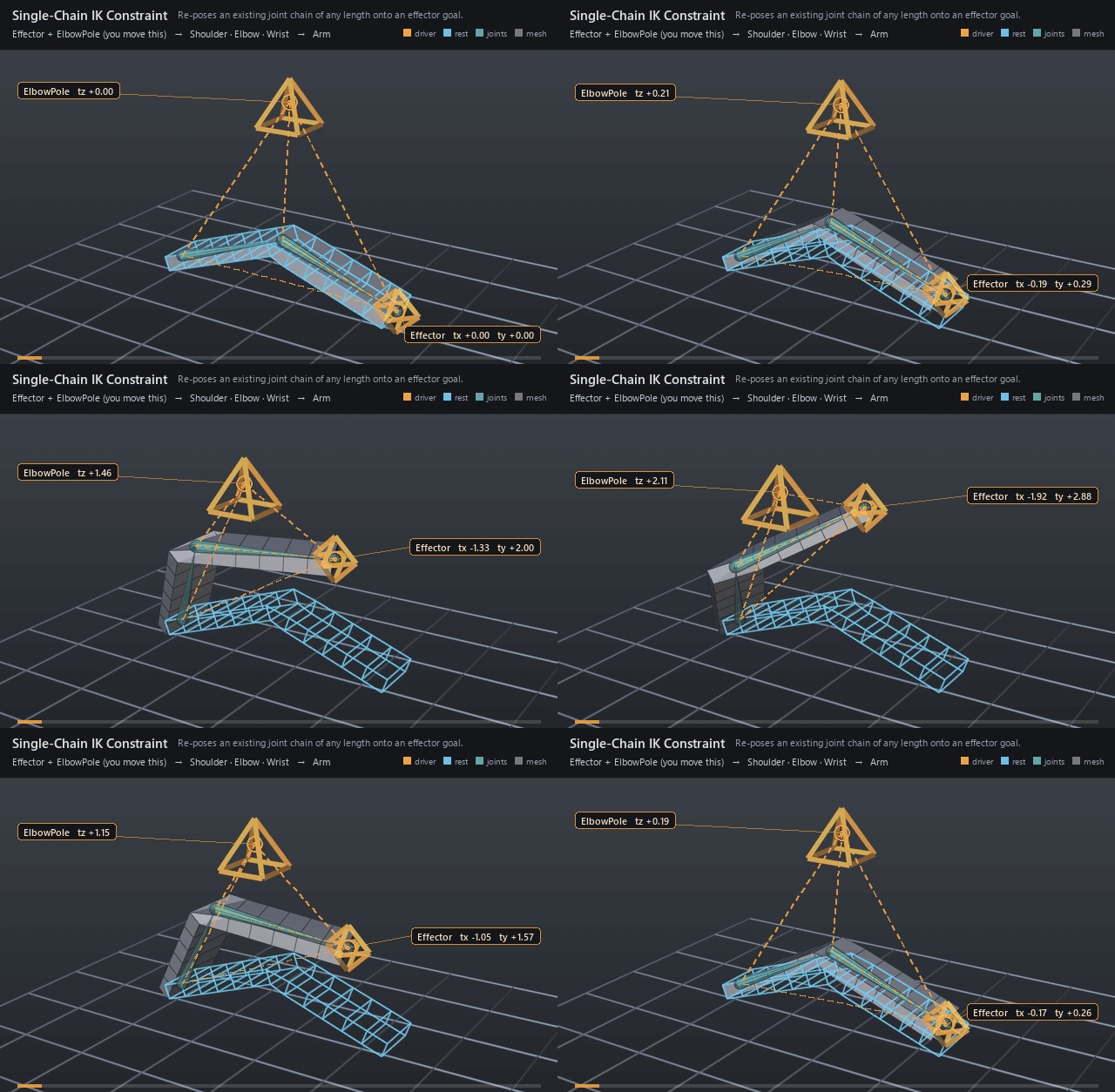
A box arm — three joints, two segments — lies along +X; the diamond effector control swings up and back over the frame range and the wrist tracks it exactly, folding the arm at the elbow. The pyramid control above the elbow is the pole-vector object, and it swings through z: the bend plane follows it, so the elbow leaves the XY plane and comes back. Two matrix movers skin the one mesh from the two bones through dense static weights that partition the points at the elbow ring.
Open it live with:
Re-render the GIF above with:
Tips
solverMode = "singleChain"ignores the pole andinputs:twistDegreesentirely — the effector's orientation picks the bend plane — and the pole relationships are not even bound in that mode, so leftover pole wiring cannot break the compile.inputs:stretchdefaults to zero: a goal past full reach returns the chain straightened down the root-to-goal ray at its original length. Set it within [0, 1] to blend uniform extension. Connected float inputs and interactive property overrides are supported.- The chain, the effector and the pole are named by their own relationships: this operator does not read the generic
rigExec:sourceslist at all. - Do not author the inherited
inputs:affect*masks or theinputs:translationOffset/rotationOffset/scaleOffsetvalues here, and do not authorrigExec:rotationOrder: this operator honors no channel group, and any authored opinion — even one equal to the default — is a compile error.