 Spline IK
Lays a joint chain along a curve built from three controls.
| Node type | RigExecSplineIk |
| Example | spline_ik.usda |
On this page:
Overview
The spine and neck solver: three controls shape an open degree-2
four-CV B-spline, and the ordered rigExec:joints chain is laid along it
by arc length. The curve is built from the posed control frames rather
than read from the stage, so unlike a Ribbon it needs no native driver
curve and a control-driven pose reaches it directly. Each joint aims +X
at its successor, a twist linear in arc position is added, and
rigExec:volumeWeights thins the off-axis handles as the curve
stretches.
Control-driven spline IK for a spine or neck, as the biped uses it. Three control frames (root, mid, end) shape an open degree-2 four-CV B-spline; the ordered rigExec:joints chain is laid along it by arc length, each joint aims +X at its successor with its rest up carried by the minimal rotation, a twist linear in arc position is added (root roll, end twist), and a linear volume-preservation scale thins (stretch) or thickens (squash) each joint's Y/Z handles. Publishes computePointFrameArray with one element per rigExec:joints entry.
Unlike RigExecRibbon, whose driver curve is native scene data and is therefore invisible to control-driven movers, this solver builds the curve itself from the posed control frames and lives entirely in the pose phase.
Rest: the rest CVs are the rest origins of joints [0], [1], [N-2], [N-1]; cv0/cv1 are carried by the root control's rest->pose map, cv2/cv3 by the end control's, and cv1/cv2 additionally receive the mid control's translation offset relative to its follow point (its rest origin carried by root and end, blended by inputs:midFollowWeight). The curve interpolates only cv0 and cv3, so interior joints carry a small rest residual that a maintained offset downstream absorbs.
How it works
Everything happens in the pose phase. Each evaluation reads the posed
and rest frames of the three controls and the rest frames of every joint
on rigExec:joints, rebuilds the rest curve from the rest origins of
joints [0], [1], [N-2], [N-1], then carries cv0/cv1 by the root control's
rest→pose map and cv2/cv3 by the end control's, adding the mid control's
translation offset from its follow point to cv1 and cv2. Joint i is
placed at arc distance ratio * (rest spacing before i) with ratio =
posed arc length / rest arc length (rigExec:restLength picks whether
that reference length is the rest curve or the rest chain), gets
roll + twist * t_i about its aim axis, and carries scale s_y = s_z =
1 - w_i * preserveVolume * (ratio - 1) on its Y/Z handles. The result is
published as computePointFrameArray, one frame per rigExec:joints
entry, which the bound joints extract view-free.
Wiring
| Relationship | Points to | Required |
|---|---|---|
rigExec:rootControl |
Provider carrying cv0 and cv1 and the root roll. | yes |
rigExec:midControl |
Provider whose translation offset bends cv1 and cv2. | yes |
rigExec:endControl |
Provider carrying cv2 and cv3 and the end twist. | yes |
rigExec:joints |
Ordered chain, root to tip: the solve's cardinality and its rest CVs. Naming a joint another step also writes stacks the two, and the last writer in that stack supplies the joint's base frame. The rest CVs and rest spacing come from the frames the joints carry ON ENTRY, so a step below this one that moves a joint changes the rest curve it solves against. | yes |
Parameters
Node parameters
purpose
Type: uniform token. Default: "guide".
Render purpose, overriding UsdGeomImageable's default
fallback: joint and solver guides are DIAGNOSTICS, drawn when a
viewer asks for guides.
This is the stock attribute rather than a RigExec-specific token so
that the bounds and the drawing cannot disagree: UsdGeomBBoxCache
classifies a prim's extent by this exact attribute, and the results
scene index stamps the same resolved value onto the guide it
synthesizes. A control keeps the inherited default -- it is the
rig's interaction surface, not a diagnostic -- and authoring
guide on one moves both its drawing and its bounds together.
rigExec:rootControl
Relationship.
Control carrying the curve start (cv0, cv1) and the root roll.
rigExec:midControl
Relationship.
Control whose translation offset from its follow point bends the interior (cv1, cv2). Its rotation and scale are ignored.
rigExec:endControl
Relationship.
Control carrying the curve end (cv2, cv3) and the end twist.
rigExec:joints
Relationship.
Ordered chain, root to tip, posed by this solve. The chain IS the solver's cardinality: it produces exactly one frame per entry, and the rest CVs and segment spacing are measured from these joints' rest frames on every evaluation.
rigExec:jointElements
Type: uniform int[]. Default: [].
Optional chain slot per rigExec:joints entry (parallel array). When absent/empty, slot = list position. When present it must be a permutation of [0, N): every slot filled exactly once.
rigExec:volumeWeights
Type: uniform float[]. Default: [].
Per-joint squash/stretch weight w_i, parallel to rigExec:joints (in chain-slot order). Empty means zero everywhere (no thinning). Reference: spine [0.1429, 0.2857, 0.4286, 0.5, 0.3571, 0.2143, 0.0714], neck [0.16, 0.32, 0.4, 0.24, 0.08].
rigExec:restLength
Type: uniform token. Default: "curve".
Valid values: curve, chain.
What the stretch ratio is measured against. curve: the
rest curve's arc length, so ratio == 1 at rest (the last joint
then overshoots the curve end by the chain/curve difference,
absorbed by maintained offsets).
chain: the sum of rest segment lengths, so the chain spans the
curve exactly.
inputs:preserveVolume
Type: double. Default: 1.
Strength of the linear volume preservation in [0, 1]: s_y = s_z = 1 - w_i * preserveVolume * (ratio - 1), s_x = 1. Zero leaves every handle at rest length; ratio < 1 thickens.
inputs:midFollowWeight
Type: double. Default: 0.5.
Blend of the mid control's follow point between its rest origin carried by the root control (0) and by the end control (1): a parentConstraint with maintainOffset on both parents.
inputs:roll
Type: double. Default: 0.
Additional roll in DEGREES about every joint's +X aim, added to the root control's own twist about the rest chain axis (the handle's roll).
inputs:twist
Type: double. Default: 0.
Additional twist in DEGREES, linear in arc position from 0 at the root to the full value at the curve end, added to the end control's twist minus the root's (the handle's twist).
rigExec:rootTangent
Type: uniform token. Default: "rigid".
Valid values: rigid, aim.
How cv1, the root's tangent CV, is posed. rigid: carried
by the root control like cv0 (a spine, clusters 0-1 under
hip_swivel_grp). aim: turned about cv0 by the minimal rotation
from the root control's posed chain axis onto the chord to the end
CV after the length floor, so the curve leaves the root pointing at
the end -- a neck, whose cluster[1] sits under a joint at the
neck control aimed at the head. Adds no twist; the mid control's offset
is applied on top.
inputs:minLengthRatio
Type: double. Default: 0.
Length floor as a fraction of the rest root->end chord; 0 switches it off. Below it the end CVs (cv2, cv3) are held that far ahead of cv0 along the root control's posed chain axis, so a chest or head driven down onto its root neither shrinks the chain past the floor nor folds it back through the root -- the end joint then overshoots its control. The mid control's follow point, the twist and the volume ratio read the control frames and are unaffected. The classical spline IK has no floor; this is a deliberate departure, and animatable per shot like every input.
guide:radius
Type: double. Default: 1.0.
Radius of the sphere and cone drawn at each aggregate element: the exact counterpart of RigExecJoint's guide:radius, including the rule that zero or negative draws no guides at all, which is how a solver's diagnostics are turned off.
Without it the elements draw at Hydra's fallback radius of 1.0, which is proportionate on an asset authored at tens of units and several times the size of the whole character on one authored at one unit.
guide:displayColor
Type: color3f. Default: (0.3, 0.6, 1.0).
guide:displayOpacity
Type: float. Default: 0.5.
rigExec:space
Relationship.
The prim whose movement away from its rest defines the space this chain is measured in -- normally a TRS master.
The spline places each joint at its rest arc spacing times
arcLength / restArcLength along the posed curve. The curve is
posed and the rest is not, so scaling
whatever the rig hangs from doubles the ratio and the solve reads
a pure scale as a 2x STRETCH: the chain still spans the curve, but
every stretch-driven effect -- volume preservation, twist
distribution -- fires as though the spine had been pulled.
Naming the space carries the rest description into it, so the ratio stays 1 and only real stretching stretches. A relationship rather than a connection for the same reason as RigExecTwoBoneIk: a control's posed space is computed, never authored.
Example
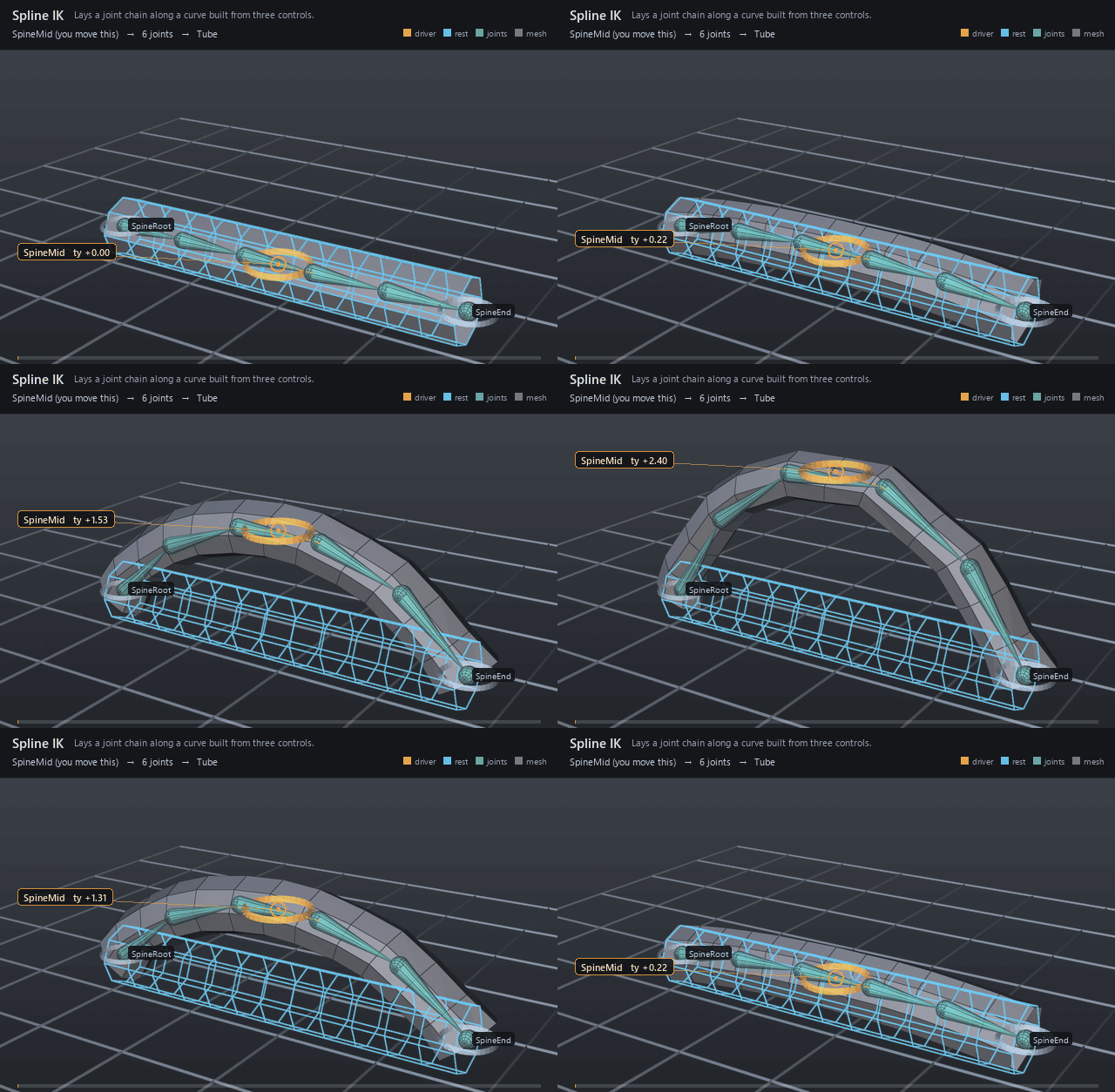
A six-joint chain rests straight along a 6-unit tube with controls at its root, middle and tip. The mid control lifts 2.4 units and comes back: the curve arches, the chain stretches from 1.2 to 1.6 units per segment to keep pace with the longer arc, and the volume weights pinch the tube by about 26 percent at the crown against the straight rest cage beneath it. Nothing but that one control is keyed.
Open it live with:
Re-render the GIF above with:
Tips
- The mid control contributes translation only — its rotation and scale are ignored. It offsets from a follow point that
inputs:midFollowWeightblends between its rest origin carried by the root control (0) and by the end control (1), so an unkeyed mid still rides between the two ends. rigExec:restLength=curvemakes the stretch ratio exactly 1 at rest;chainmakes the chain span the curve exactly. The two only differ when the rest chain is not itself the rest curve — a straight rest chain (like the docs example) gives identical results, a curved rest spine does not.inputs:minLengthRatiofloors the chain: below that fraction of the rest root→end chord the end CVs are held that far ahead of cv0 along the root's posed chain axis, so an end control driven down onto its root cannot fold the curve back through it. The biped spine and neck both run at 0.5; the default 0 switches it off.